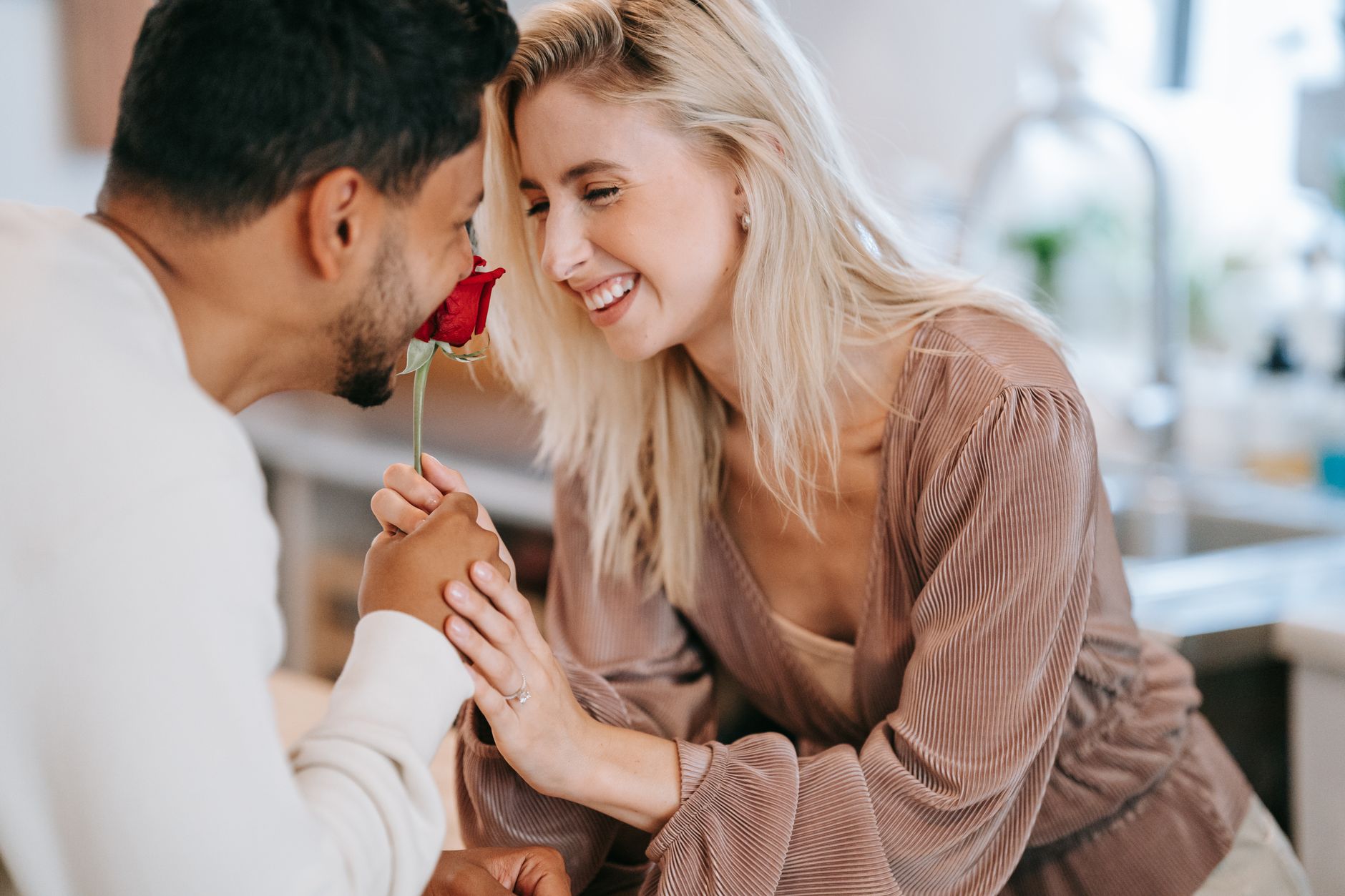
We are going to be honest about something that most florist websites will not say: sending flowers in a romantic context is terrifying. Not the logistics. The logistics are easy — you pick an arrangement, you type an address, you pay, we deliver. The terrifying part is everything else. Is it too soon? Is it too much? Is it the wrong flower? Will she think it is performative? Will he think it is weird? Will they read the card in front of coworkers and die of embarrassment?
At eugeneflorist.com, we have delivered flowers to every stage of romance imaginable — from anonymous first-date follow-ups to 50th anniversary arrangements, from giddy college crushes to quiet Tuesday-morning surprises between people who have shared a bathroom for fifteen years. And the thing we have learned is that the rules change at every stage, nobody writes them down, and most people are guessing.
So here they are. The unwritten rules, written down. Stage by stage, from the very beginning to the deep middle of a long relationship. With specific flower advice, card language, and the kind of honesty you only get from people who have watched thousands of love stories play out one delivery at a time.
📱 Stage 1: “We’re Talking”
You matched on an app. You have exchanged some messages. Maybe you have had one coffee date. Maybe you have not even met in person yet. And somewhere in the back of your mind, a thought appears: should I send flowers?
The short answer: probably not yet. At this stage, flowers are a grand gesture, and grand gestures before there is a foundation feel less romantic and more alarming. The person does not know you well enough to interpret the gesture the way you intend it. What you mean is “I think you are interesting and I am excited.” What they might hear is “I have already planned our wedding and named our children.”
The exception: if you have already been on two or three genuinely great dates and there is unmistakable mutual energy, a small gesture can work. Not a dozen roses. Not an arrangement delivered to their workplace. Something like: “I saw these at the Saturday Market and thought of you” — handed in person, casually, with zero expectation attached. A single stem or a small hand-tied bunch. The key is that it feels spontaneous, not orchestrated.
Eugene-specific note: if you are both UO students or recent grads, the campus dating culture runs casual. A hand-picked bunch from the Saturday Market flower vendors is peak Eugene romance at this stage. Low-key, local, charming.
🍽️ Stage 2: “We’ve Been on a Few Dates”
You have been out three, four, five times. You text every day. You have inside jokes. You are not yet “official,” but you are clearly headed somewhere. This is the stage where flowers become a real option — and where they can be genuinely powerful.
Sending flowers at this stage is a deliberate escalation. It says: I am taking this seriously. You are not just someone I am hanging out with. I thought about you when you were not in front of me, and I acted on it. In a world of non-committal texting and situationship ambiguity, that clarity is attractive.
What to send: a medium arrangement in bright, cheerful colors. Not red roses (too loaded, too soon). Think seasonal mixed flowers — something that looks like spring, feels joyful, and does not carry the weight of a declaration. Browse our current arrangements for options in that range.
Where to send: their home, not their workplace. At this stage, you do not want them fielding questions from coworkers about who sent flowers. Home delivery lets them have the moment privately — and then tell whoever they want, on their own terms.
What to write on the card:
- “Last Tuesday was really fun. These reminded me of your energy.”
- “No occasion. Just thinking about you.”
- “I saw these and thought: yeah, that is exactly right.”
Keep it short. Keep it warm. Do not write a novel. The flowers are doing most of the talking — the card just needs to confirm what they already suspected: that you are paying attention.
🤝 Stage 3: “We’re Official”
You have had the conversation. You have deleted the apps (or at least muted them). You are introducing each other to friends. Congratulations — you are now in a relationship, and the flower rules change.
At this stage, flowers are no longer a bold move. They are a language. And the most important thing to understand is that the best romantic flowers are the ones that are not attached to an obligation.
Birthday flowers? Expected. Valentine’s Day flowers? Required. Anniversary flowers? Noted. All of those are good and you should absolutely send them (see our romance collection). But the flowers that actually change the temperature of a relationship are the ones that arrive on a random Wednesday for no reason at all.
The “just because” bouquet is the most underrated move in all of romance. It says: I was not reminded by a calendar. I was not guilted by a holiday. I just thought about you in the middle of a normal day and decided to do something about it. That hits differently than anything you send on February 14th.
What to send: this is where you start learning their preferences. Do they love peonies? Garden roses? Sunflowers? Wildflower-style arrangements? Pay attention to what they react to. A partner who notices what flowers their person loves and sends those specific ones is a partner who is paying the kind of attention that builds lasting relationships.
Card language for the official stage:
- “Tuesday. No reason. Just you.”
- “Saw these and they looked like the way you laugh.”
- “I like us. Here are some flowers about it.”
🏠 Stage 4: “We Live Together”
You share a space now. You see each other every day. The grand romantic gestures of early dating have settled into something quieter, more domestic, more real. And this is exactly where most people stop sending flowers — which is exactly why you should not stop.
Living together creates a paradox: you are closer than ever, but the gestures that signal romantic attention often fade. You stop dressing up for each other. You stop making plans that feel like dates. You stop doing the things that say I chose you today because the choosing feels like it already happened. Flowers are one of the simplest ways to push back against that drift.
Flowers for the home you share are different from flowers you send to someone else’s apartment. They are not a message — they are an atmosphere. A vase of fresh flowers on the kitchen table or the nightstand changes how a room feels, and the person who put them there is saying something without saying anything: I want our space to be beautiful. I want you to walk in and feel something good.
At this stage, the best move is a standing habit. Not necessarily a subscription (though we can do that). Just a rhythm. A bunch from the Saturday Market every other week. A delivered arrangement on the first of the month. Something that says: romance is not a phase we went through. It is a thing we maintain.
The argument recovery bouquet: let us talk about this, because it comes up. Flowers after a fight are a complicated gesture. If you send them too quickly, they feel like a shortcut around the actual conversation. If you send them instead of apologizing, they feel manipulative. But if you have done the work — had the conversation, taken responsibility, genuinely repaired things — and then flowers arrive the next day with a card that says “I meant what I said last night. I am sorry. I love you.” — that is not a shortcut. That is a follow-through. And follow-through matters.
📅 Stage 5: “It’s Been Five Years”
You know each other deeply now. You know how they take their coffee, which side of the bed they need, what face they make when they are pretending to be fine but are not. The mystery of early dating is gone and in its place is something richer but less electric. This is the stage where most couples have completely stopped sending flowers to each other.
Which is precisely why flowers at this stage land harder than at any other point in the relationship.
A bouquet that arrives in year one is exciting but expected. A bouquet that arrives in year five, on a nothing Tuesday, for no occasion, with a card that says “Five years and I still think about you when you are not in the room” — that is the kind of gesture that makes someone cry at the kitchen counter in the best possible way.
The longer you have been together, the more a spontaneous romantic gesture stands out against the background of routine. It is the contrast that gives it power. You are not proving anything. You are not performing. You are just saying: I have not stopped noticing you.
What to send at five years: something that reflects what you have learned about them. Their favorite color. Their favorite flower, if they have mentioned it in passing three years ago (and you remembered). A potted plant for the garden they have been building. An orchid for the windowsill they look at every morning while drinking coffee. The specificity is the romance.
💕 Stage 6: “It’s Been Ten (or Twenty, or Thirty) Years”
We are going to say something that long-term couples already know but rarely hear from a florist: the relationships that last decades are the ones where someone still makes an effort. Not grand effort. Not performative effort. Just the steady, quiet effort of saying I see you, I value you, I am still here on purpose — over and over, year after year.
Flowers are one of the easiest, most tangible ways to make that effort visible. And yet the people who have been together the longest are the least likely to send them. There is an assumption that romance is for new couples, that long-term love does not need gestures, that after twenty years you have “moved past” flowers. We see it differently. After twenty years, flowers mean more, not less. Because after twenty years, nobody is trying to impress. There is no audience. There is no performance. There is just one person deciding to do something kind for another person they have loved for a very long time.
What to send at ten or twenty years:
- A premium arrangement in their favorite colors — the ones you have watched them gravitate toward for a decade
- A living plant for the garden you have built together — something that will bloom next year and the year after that
- A recreation of the first flowers you ever gave them (if you remember what they were — and if you do, that fact alone is the real gift)
- Flowers delivered to their office with a card that says: “Still my favorite person in every room.”
✏️ The Card at Every Stage (A Cheat Sheet)
The card is the part they keep. Here is a quick reference for every stage:
- Early dating: “No occasion. Just thinking about you.” (Short. Warm. No pressure.)
- Newly official: “I like us. Here are some flowers about it.” (Playful. Confident.)
- First birthday together: “Happy birthday to someone who makes ordinary days feel like good ones.”
- First Valentine’s Day: “I know this holiday is a cliché. I do not care. You deserve flowers today.”
- Living together: “For the kitchen table. And for you.”
- After an argument: “I meant what I said. I am sorry. I love you.” (Only works if you actually said you were sorry first.)
- Five years: “Five years and I still think about you when you are not in the room.”
- Ten years: “A decade. I would do it all again. Starting now.”
- Twenty years: “Still my favorite person in every room.”
- Just because (any stage): “Wednesday. No reason. Just you.”
🚫 The Mistakes (Because We Have Seen Them All)
A few things to avoid, learned from years of watching romantic flower orders go right and wrong:
- Do not send flowers as a substitute for a conversation. Flowers after a fight are a follow-up, not a replacement. If you have not actually talked about it, the flowers will feel like a bribe.
- Do not send red roses to someone you have been on two dates with. Red roses carry a cultural weight that says “I love you” whether you intend that or not. Save them for when you mean it.
- Do not send flowers to their workplace if they have not told coworkers about you yet. Public romance is great when both people are ready for it. Forced public romance is a different thing entirely.
- Do not write a card that is longer than four sentences. A card is not a letter. If you have that much to say, say it in person and let the card be the punctuation.
- Do not only send flowers when you are in trouble. If the only time your partner receives flowers is after you have done something wrong, flowers become associated with problems instead of joy. Send them when everything is fine. That is the whole point.
🌺 The Move Nobody Expects
We want to end with the single best romantic flower move we have seen in our years of delivering in Eugene, because it is so simple and so effective that it should be more common than it is.
Send flowers to yourself and your partner’s shared home, timed to arrive while they are there and you are not.
They open the door. They see a delivery. They read the card. You are not even there. You are at work, or running errands, or picking up the kids. And the card says something like: “I ordered these this morning because I woke up next to you and felt grateful. See you tonight.”
That is the move. It requires no audience. It asks for nothing in return. It is romance in its purest form: one person thinking about another person and acting on it, quietly, without fanfare. And it works at every single stage — from the first month to the thirtieth year.
💐 Order Flowers for the Person You Love
At eugeneflorist.com, we deliver flowers across Eugene, Springfield, and Lane County — same-day when you need it, or scheduled for the perfect moment when you plan ahead. We have arrangements for every stage of romance, from the first cautious gesture to the anniversary that reminds you both why you started.
href="/gifts-occasions" title="Gift Baskets"