
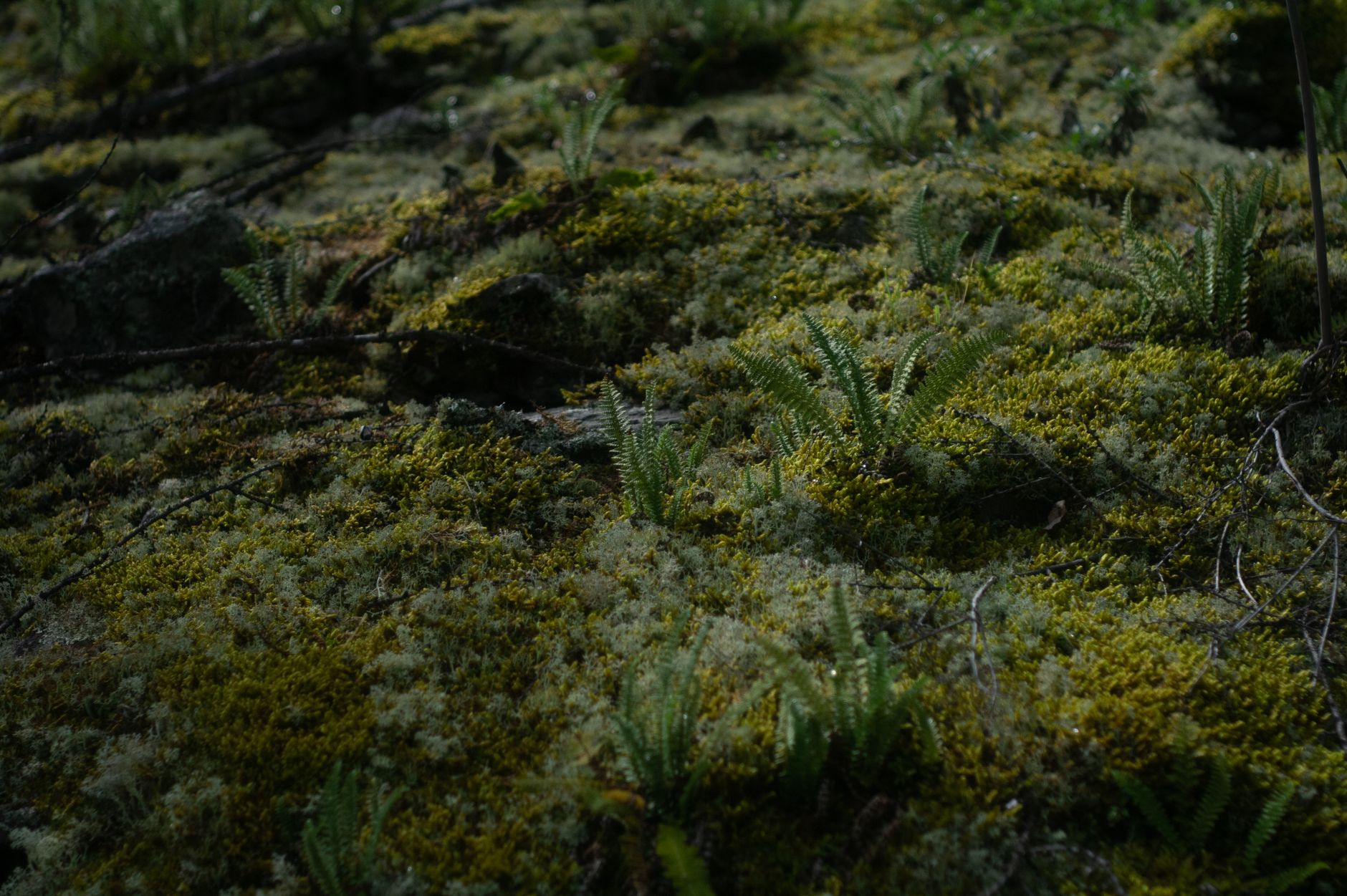
You walk into an Oregon forest and the first thing that hits you is green. Not flowers. Not birds. Not the canopy. The green. It is everywhere — coating every surface, draping from every branch, covering the ground in layers so thick you cannot see soil. Ferns three feet tall. Moss on every rock and log. Lichens hanging from branches like torn fabric.
This is the forest floor layer — the part of the ecosystem most people walk through without thinking about. But as a florist in Eugene, these are the plants I think about constantly. Because the same species that make an Oregon forest feel like an Oregon forest are the ones that make a flower arrangement feel finished, lush, and alive.
This is a love letter to the green things.
🌿 The Ferns
Oregon has over 100 species of ferns. The ones you see most often in the forests around Eugene:
- Sword fern (Polystichum munitum): The workhorse. Evergreen, tough, and everywhere. Those dark green fronds growing in circular crowns on the forest floor — that is sword fern. It is also one of the most used greens in professional floristry. We go through hundreds of stems a week. It lasts forever in a vase, fans beautifully behind flowers, and gives arrangements that Northwest character that no tropical green can replicate.
- Lady fern (Athyrium filix-femina): More delicate than sword fern — lighter green, lacier fronds, deciduous. Common along streams and in moist shade. Occasionally used in wedding work for its ethereal texture.
- Maidenhair fern (Adiantum): The most beautiful fern in Oregon. Black wire-thin stems with fan-shaped leaflets that tremble in any breeze. Found near waterfalls and seeps. Florists use maidenhair fern in bridal work and high-end designs — it is delicate, romantic, and unmistakable.
- Deer fern (Blechnum spicant): Smaller, with two types of fronds — sterile spreading ones and upright fertile ones. Common on forest floors and road cuts throughout the Coast Range and Cascades.
- Licorice fern (Polypodium glycyrrhiza): The one growing on tree trunks and mossy branches. Small, bright green, and epiphytic — it does not need soil. Chew the root and it tastes like licorice. Genuinely.
🟢 The Mosses
Oregon’s moss game is world-class. The Willamette Valley and Coast Range are among the mossiest places on Earth — the combination of mild temperatures, winter rain, and summer fog creates conditions that mosses thrive in:
- Sheet moss (Hypnum): The flat, carpet-like moss covering logs and rocks. In floristry, sheet moss is used to cover soil in potted arrangements, line baskets, and create naturalistic bases for tablescapes.
- Sphagnum moss: The spongy, water-holding moss from bogs. Critical in floristry as a lining material for hanging baskets and wire-frame arrangements. Holds 20 times its dry weight in water.
- Spanish moss (Tillandsia usneoides): Not technically a moss (it is a bromeliad) and not native to Oregon, but widely used in floristry for draping, texturing, and creating a moody, Southern Gothic aesthetic. We keep it in stock year-round.
- Reindeer moss (Cladonia): Actually a lichen, not a moss. The spongy, branching clumps that come in natural gray-green or dyed colors. Popular in terrariums, wreaths, and modern arrangements for texture.
🍃 The Foliage Layer in Professional Floristry
Here is what most people do not realize: the greenery in a flower arrangement is doing 60–70% of the visual work. Flowers are the stars, but foliage is the cinematography. Without it, flowers look sparse, disconnected, and flat. With the right greens, even a modest bouquet looks lush and intentional.
The foliage a professional florist uses daily:
- Sword fern: Structure and backdrop. The fan shape fills space behind and below flowers.
- Salal (Gaultheria shallon): Leathery, round leaves on arching stems. Native to Oregon. The most common “background green” in American floristry. Harvested commercially in the Coast Range.
- Eucalyptus (seeded, silver dollar, willow): Australian import but ubiquitous in modern floristry. Silver-green, fragrant, and photographs beautifully. The “Instagram green” of the last decade.
- Ruscus (Italian and Israeli): Dark, glossy, almost plastic-looking leaves on stiff stems. Incredible vase life — two weeks easily. The structure green in formal work.
- Leather fern (Rumohra adiantiformis): Imported from Florida and Central America. Tougher than Oregon ferns, with a glossy finish. The standard fern green in everyday arrangements nationwide.
- Pittosporum: Small-leaved, slightly fragrant, with variegated or solid green varieties. Fills the middle layer beautifully.
- Bear grass (Xerophyllum tenax): Long, flexible blades that curve and loop. Native to Oregon’s mountains. Used to add movement and line to modern and wedding designs.
🌲 Why the Forest Floor Matters Ecologically
The fern-and-moss layer is not decorative. It is functional (and if you want the full story on how pollinators interact with the flowers that grow above this layer, read our guide to pollinators, hummingbirds, butterflies, and bees):
- Water retention: Moss and fern litter hold massive amounts of rainfall, releasing it slowly and preventing erosion. A healthy forest floor is a sponge.
- Nurse logs: Fallen trees coated in moss become nurseries for new trees. Hemlock and spruce seedlings germinate directly on decaying, moss-covered logs. The next generation of forest literally grows from the corpses of the last one.
- Microhabitat: Salamanders, insects, slugs (the banana slugs!), and fungi all depend on the moist, shaded conditions the fern layer creates.
- Mycorrhizal networks: Below the moss layer, fungal networks connect tree roots across the forest. The “wood wide web” runs beneath your feet every time you hike Spencer Butte or Pisgah.
🚶 Where to See the Best Forest Floor Near Eugene
- Shotgun Creek Recreation Area: Old-growth pockets with incredible fern understory. 30 minutes northeast of town.
- Sweet Creek Falls Trail: The trail runs along a creek through a moss-draped canyon. Every surface is green. About an hour west toward Mapleton.
- Hendricks Park Native Plant Garden: Curated native fern and moss displays within walking distance of campus.
- Pisgah Arboretum: The Howard Buford Recreation Area side has old-growth sections where the forest floor is dense with ferns and moss. (Our Spencer Butte wildflower guide and Lane County hiking guide cover more trails nearby.)
- Any trail in the Coast Range: Drive west 45 minutes in any direction. The second-growth Douglas fir forests along the way have sword fern understories so thick you cannot see the ground.
🌺 A Florist’s Perspective
When I design an arrangement, I am building a tiny ecosystem. The flowers are the canopy — the showy, attention-getting layer. But the greenery is the forest floor — the part that makes everything above it look grounded, natural, and real. Without ferns, without salal, without eucalyptus and ruscus and moss, flowers just sit in a vase looking lonely.
Every time you walk through an Oregon forest and feel that sense of lushness — that “everything is alive” feeling — you are responding to the same thing you respond to in a well-made bouquet. The green stuff. The supporting layer. The plants nobody names but everybody feels.
That is why they matter. That is why we use them. That is why I love them.
Browse our arrangements and plants. Every bouquet we build starts with the greenery — Oregon sword fern, salal, eucalyptus, and seasonal foliage that gives flowers a reason to look this good. Curious about where our flowers come from? Read about organic flowers and the supply chain. Same-day delivery across Eugene and Springfield.