Every flower arrangement on your table exists because a pollinator visited a flower at some point in the supply chain. No bees, no seed. No seed, no farm. No farm, no roses at wholesale on Monday morning. The entire cut flower industry — billions of stems a year — depends on the silent contract between plants and the animals that move their pollen.
But here is what most people do not realize: pollinators do not see flowers the way you do. The colors, shapes, and fragrances that draw you to a bouquet evolved for an entirely different audience — one with ultraviolet vision, a tongue longer than its body, or a navigation system that uses the sun’s polarization to find its way home.
This is the story of what pollinators actually see, why they choose what they choose, and how the same flowers that evolved to attract wildlife also happen to be stunning in a vase.
🐝 What Bees See (And It Is Not What You Think)
Honeybees and native bees see the world in ultraviolet, blue, and green — but they cannot see red. A pure red flower looks black or dark gray to a bee. This is why most bee-pollinated flowers are blue, purple, yellow, or white — colors that pop in bee vision.
But it gets stranger. Many flowers have ultraviolet nectar guides — patterns on their petals that are invisible to humans but function like runway lights for bees. A sunflower that looks uniformly yellow to you has a dark bullseye center in UV that says “land here.” A white daisy has UV streaks on its petals pointing inward like arrows.
Bee favorites in the flower shop:
- Lavender: Purple, fragrant, and loaded with nectar. Bees go absolutely wild for it. In arrangements, it adds fragrance, texture, and a relaxed cottage feel.
- Sunflowers: The UV bullseye makes them irresistible to bees. In a vase, they are pure joy — big, bold, and impossible to ignore.
- Dahlias: Open-centered dahlias (single and collarette types) are bee magnets. The decorative “dinner plate” types are less accessible but still beautiful.
- Snapdragons: Bees are heavy enough to push open the “jaw” of a snapdragon and crawl inside. Lighter insects cannot. This is a lock-and-key pollination system.
- Sweet peas: Blue-purple-pink range that glows in bee vision. The fragrance is a bonus lure.
- Zinnias: Open, flat, easy to land on, full of pollen. The fast-food drive-through of the bee world.
🦋 What Butterflies Want (And Why It Is Different From Bees)
Butterflies can see red — which bees cannot — and they prefer flat-topped or clustered flowers where they can land and rest while feeding. Unlike bees (which hover and crawl), butterflies need a landing pad. Their tongues (proboscises) are long and thin, so they prefer tubular florets packed into flat clusters.
Butterflies also see well in the red-orange-pink spectrum, which is why so many butterfly flowers are warm-toned. They are less interested in fragrance (their sense of smell is weaker than bees) and more driven by color and shape.
Butterfly favorites that cross into floristry:
- Zinnias: Flat landing surface, bright colors, abundant nectar. The number-one butterfly magnet in any garden.
- Asters: Late-season daisy-family flowers in purple, pink, and white. Butterflies love the clustered florets. Asters appear in fall arrangements frequently.
- Phlox: Clusters of tubular florets in every color. Garden phlox draws swallowtails; annual phlox is a cut-flower staple.
- Scabiosa (pincushion flower): Rounded heads with tiny tubular florets. Beloved by painted ladies and skippers. A popular filler flower in wedding work.
- Yarrow: Flat-topped clusters that function as butterfly rest stops. Yellow, white, and pink varieties show up in rustic and wildflower-style arrangements.
- Echinacea (coneflower): The raised cone center is perfect for butterfly landing. Dried echinacea heads appear in texture-forward modern arrangements.
🐦 What Hummingbirds See (And Why Red Matters)
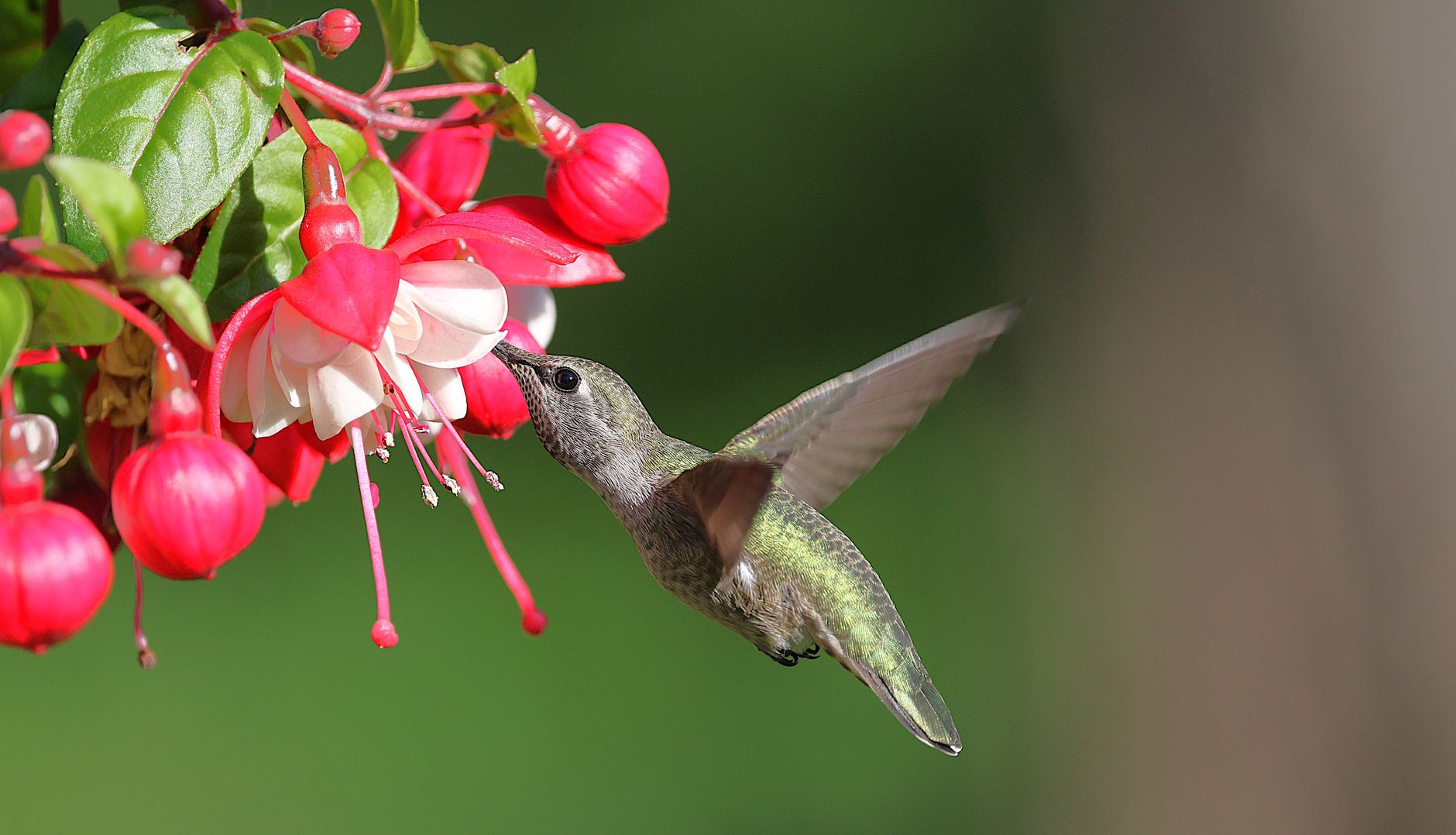
Hummingbirds have excellent color vision — including the ability to see red, which bees cannot. This is not a coincidence. Red tubular flowers evolved specifically for hummingbirds because the color excludes bees (who cannot see it and therefore ignore it), reserving the nectar for the one pollinator with a bill long enough to reach it.
Hummingbird flowers tend to be:
- Red, orange, or hot pink (visible to birds, invisible to bees)
- Tubular or trumpet-shaped (matching the long bill and tongue)
- Unscented (birds navigate by sight, not smell)
- Pendant or dangling (accessible to hovering but not to landing insects)
Hummingbird favorites that show up in arrangements:
- Fuchsia: Dangling, tubular, red-and-purple. The quintessential hummingbird flower. In hanging baskets and garden containers, not typically cut — but gorgeous as a living gift.
- Salvia (sage): Tubular spikes in red, purple, coral, and blue. Hot lips salvia is a hummingbird magnet. Cut salvias appear in garden-style and wildflower arrangements.
- Crocosmia: Arching sprays of red-orange tubular flowers. Hummingbirds love them. Florists use them for dramatic line and movement in summer arrangements.
- Penstemon: Tubular bells in red, pink, and purple. Native penstemons draw hummingbirds across the West. Occasionally appears in locally-sourced designs.
- Honeysuckle: Tubular, fragrant (to humans — birds do not care about the scent), and loaded with nectar. Not a typical cut flower but beautiful in trailing garden arrangements.
- Red hot poker (Kniphofia): Torch-shaped spikes of red-orange-yellow. Dramatic in tall arrangements. Irresistible to hummingbirds in the garden.
🌻 The Overlap: Flowers That Work in Both the Garden and the Vase
Here is what makes this topic fascinating for a florist: many of the best pollinator plants are also excellent cut flowers. The same traits that attract wildlife — vivid color, strong form, abundant nectar, interesting texture — are exactly what makes a flower look great in an arrangement.
- Sunflowers: Bee-pollinated in the field, show-stopping in a vase. The UV nectar guide that draws bees is invisible to us but the golden color is universally loved.
- Dahlias: Pollinator buffet in the garden, centerpiece queen on the table. Open-centered varieties are better for bees; decorative types are better for cutting — but all are beautiful.
- Zinnias: Butterfly paradise and florist workhorse. They grow prolifically, cut beautifully, and come in every color except blue.
- Scabiosa: Butterfly magnet and bridal bouquet darling. The wiry stems and airy texture make it a designer favorite.
- Cosmos: Attracts bees and butterflies, looks ethereal in a loose garden-style arrangement. The chocolate cosmos even smells like chocolate.
- Echinacea: Butterfly landing pad fresh, sculptural drama dried. Works in modern, rustic, and wildflower designs.
🔍 UV Vision: The Hidden World on Every Petal
If you could see in ultraviolet — like a bee — every bouquet would look completely different. Flowers that appear solid-colored to us often have elaborate UV patterns that serve as pollinator landing guides:
- Black-eyed Susans: The dark center is even darker in UV, creating a high-contrast bullseye
- Evening primrose: Has UV-absorbing patches at the petal base that create a bright ring visible only to bees
- Marsh marigold: Reflects UV strongly on petal tips, creating a glowing halo effect in bee vision
- Roses: Most roses have UV-absorbing bases that create a dark center star pattern — invisible to us, unmistakable to bees
Your rose bouquet is secretly covered in invisible art. You just do not have the eyes to see it.
🌿 Why This Matters for Your Garden (and Your Conscience)
If you love receiving flowers, you already love what pollinators create. Here is how to give back:
- Plant pollinator-friendly flowers at home: Even a small patio container of lavender, salvia, and zinnias provides food for local bees and butterflies.
- Choose open-centered varieties: Double flowers (bred for extra petals) often sacrifice their nectar and pollen access. Single or semi-double varieties feed wildlife better.
- Skip pesticides on blooming plants: Neonicotinoids are particularly deadly to bees. If you are growing flowers to attract pollinators, keep the chemistry away from blooming stems.
- Leave some “mess” in the garden: Native bees nest in bare soil, hollow stems, and leaf litter. A perfectly manicured yard is a pollinator desert.
- Support local flower farms: Small-scale growers who practice integrated pest management and grow diverse varieties are doing more for pollinators than industrial monoculture operations.
🌺 The Bottom Line
Every cut flower in every arrangement was pollinated by something — a bee, a butterfly, a hummingbird, a moth, a bat, or the wind. The colors that make you reach for a bouquet evolved to attract a creature that sees the world completely differently than you do. And the same flowers that look stunning on your table are feeding, sheltering, and sustaining the wildlife that makes the next generation of flowers possible.
When you send flowers, you are participating in a system that is millions of years old. The beauty is not accidental. It is bait — and it works on humans just as well as it works on bees.
Browse our arrangements, garden plants, and gifts for nature lovers. Same-day flower delivery available.