It happened Tuesday. The box came in from our grower. Standard brown cardboard, nothing special on the outside. But we knew. We had been waiting since October — since the last frost turned the plants to mush and the tubers went into the ground to sleep and we spent nine months pretending other flowers were good enough.
We opened the box. And there they were. The first dahlias of the season. Fat, absurd, impossibly colored. One was the size of a salad plate. One was a perfect sphere of interlocking petals so precise it looked machine-made. One was a shade of coral that does not exist in the crayon box.
Dahlia season has officially started in the Willamette Valley. And we are warning you now: we are going to be insufferable about it until the first frost kills them in October. Three months of peak obsession. You have been warned.
🌺 Why Dahlias Are the Most Oregon Flower
Most people do not know this: Oregon grows more dahlia tubers than anywhere else in the United States. The Willamette Valley — specifically the Canby/Silverton/Woodburn corridor about an hour north of Eugene — is dahlia central. The soil is right (rich, well-drained volcanic loam). The climate is right (warm summers, mild falls, enough rain to keep things going without drowning the tubers). The tradition is right (Swan Island Dahlias has been farming there since 1927).
When you buy dahlias from a Eugene florist in July, they almost certainly grew within 90 miles of your house. They were probably in the ground 48 hours ago. They did not fly across the country in a refrigerated box from Colombia or Ecuador like your February roses did. They grew here. In Oregon dirt. Under Oregon sun. Watered by Oregon rain (and Oregon irrigation, because July).
This matters because dahlias are absurdly local. They do not ship well — the petals bruise, the stems are hollow and fragile, and they have zero tolerance for dehydration. A dahlia picked in Canby on Tuesday morning is on your kitchen table in Eugene by Tuesday afternoon. That is the supply chain. That is the whole thing. Farm to vase in hours, not days.
🏷️ The Forms (Because Dahlias Contain Multitudes)
Here is what makes dahlias unique in the flower world: they are not one shape. They are at least fifteen officially recognized forms, and most people only know about two of them (the big ones and the round ones). Here is the full field guide:
- Dinner Plate — the showstoppers. Heads 8–12 inches across. Flat to slightly cupped. One stem fills a vase. The ones that make people stop and say “wait, that is a real flower?” Varieties: Café au Lait (blush/cream), Kelvin Floodlight (yellow), Emory Paul (pink).
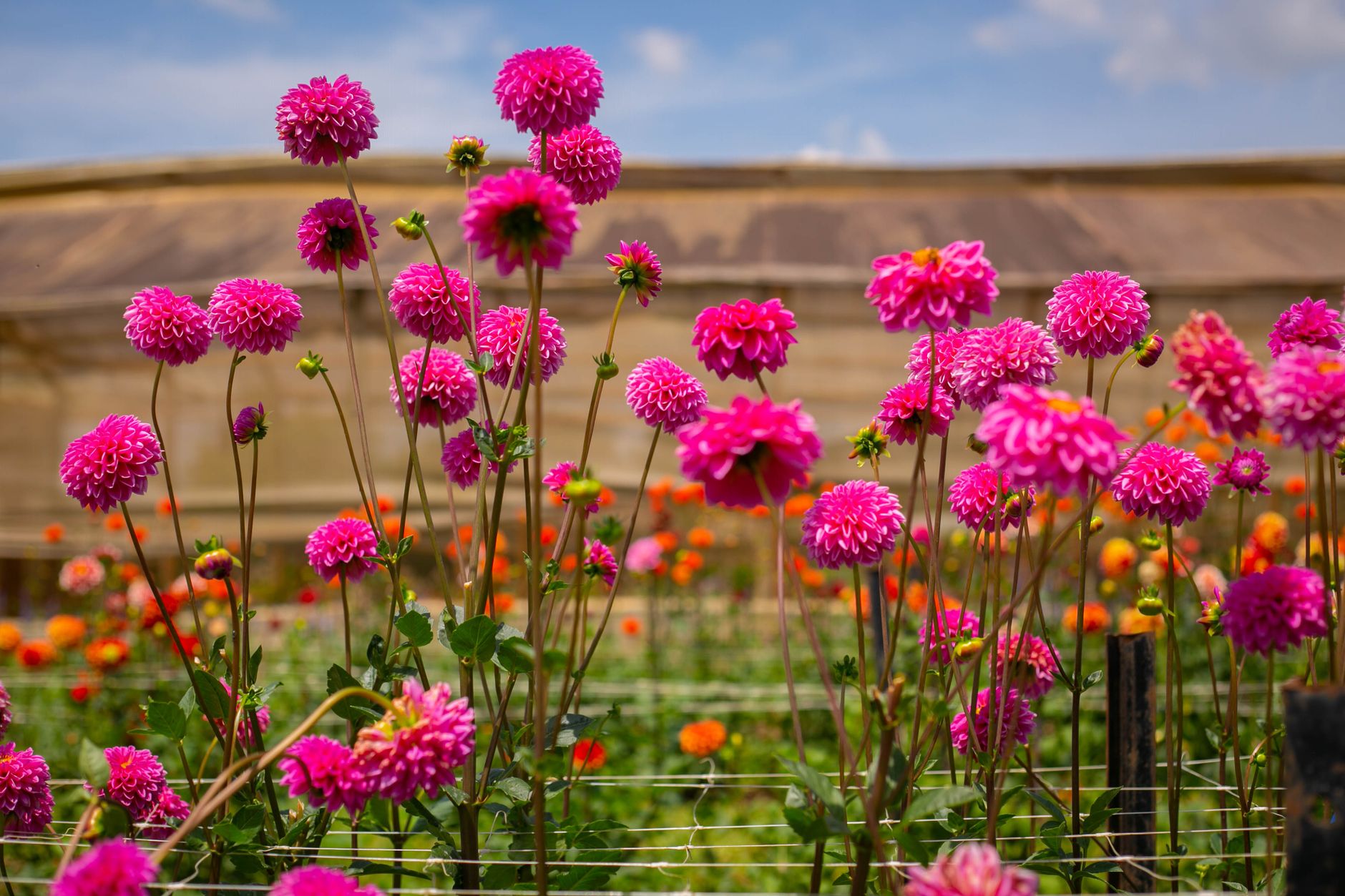
- Ball — perfectly spherical, honeycomb-patterned petals that roll inward. Tennis ball to softball sized. Geometrically satisfying in a way that triggers something deep in the brain. Varieties: Wizard of Oz (pink), Jomanda (orange-red).
- Pompon — miniature balls. Under 2 inches across. Round as a gumball. Absurdly cute. They come in clusters on branching stems and look like candy. Varieties: Franz Kafka (lilac), Sunny Boy (yellow).
- Cactus — petals rolled into pointed tubes that radiate outward like a sea urchin or a punk hairstyle. Dramatic, textural, unlike anything else in the flower world. Varieties: Karma Sangria (red), Veritable (pink-coral).
- Semi-Cactus — petals that roll partway but still have broader tips. The middle ground between cactus drama and decorative fullness. Varieties: Mingus Alex (yellow-red bicolor).
- Decorative (Formal) — flat petals arranged in a regular pattern, fully double, no disk center visible. The “classic dahlia” shape most people picture. Varieties: Thomas Edison (deep purple), Arabian Night (near-black maroon).
- Decorative (Informal) — same as formal but with petals that twist, curl, or arrange irregularly. More relaxed, more movement. Varieties: Café au Lait (yes, she is both dinner plate and informal decorative — the queen contains multitudes).
- Waterlily — fewer petal layers, broad and flat, giving a shallow, open appearance like a waterlily floating on a pond. Elegant and understated. Varieties: Camano Cloud (white), Karma Prospero (lavender).
- Collarette — a single outer ring of large petals surrounding an inner “collar” of smaller petals, with a visible disk center. Two-toned and whimsical. Varieties: Pooh (orange with yellow collar), Night Butterfly (dark red with white collar).
- Anemone — one or more outer rings of flat petals surrounding a dense pincushion center. Looks like a different flower entirely. Varieties: Totally Tangerine (orange), Purpinka (purple).
- Single — one ring of petals around an open center disk. Simple, daisy-like, beloved by pollinators. Varieties: Bishop of Llandaff (red with dark foliage — the famous one).
- Orchid — single ring of petals that fold backward or inward along their length. Starfish-shaped. Unusual and compelling. Varieties: Honka (white/yellow).
- Stellar — short, cupped petals that curve inward, giving a star-shaped appearance. Compact and architectural. Varieties: Verrone’s Obsidian (near-black).
This is not a complete list. There are lacinated forms (fringed tips), peony forms (open center, multiple petal rows), and novelty forms that defy classification. The American Dahlia Society recognizes over 20,000 named cultivars. Twenty. Thousand. No other garden flower comes close to that kind of diversity from a single genus.
🎨 The Color Situation
Dahlias come in every color except true blue. Every. Single. Other. Color. Including colors that seem impossible:
- Near-black (actually deepest maroon): Arabian Night, Verrone’s Obsidian
- Coral that shifts to peach in different light: Café au Lait, Labyrinth
- Burgundy so dark it absorbs light: Rip City, Black Jack
- Acid yellow that almost glows: Kelvin Floodlight, Clearview Daniel
- Lavender that reads as gray in certain arrangements: Creme de Cassis, Blue Boy (which is not blue at all — it is lilac)
- Bicolors with stripes, tips, and gradients: Santa Claus (red and white), Duet (red and white formal), Seattle (gold and white tips)
- Pure white: White Perfection, White Star, Brookside Snowball
The color range is why designers and wedding florists go slightly insane during dahlia season. You can match any palette. Any mood. Any aesthetic. No other flower offers this level of chromatic precision. If you can imagine the color, there is a dahlia variety in that exact shade.
💔 Why Dahlias Are a Florist’s Nightmare (That We Love Anyway)
Here is the honest truth: dahlias are difficult. We adore them and they make us crazy. Here is why:
- Short vase life. 4–7 days, depending on variety and conditions. Compare that to a rose (10–14 days) or a chrysanthemum (2–3 weeks). Dahlias are sprinters, not marathoners.
- Hollow stems. The stems are not solid — they are hollow tubes that kink and crush easily. Cutting them requires care. Arranging them in floral foam requires a support trick (we insert a short piece of thicker stem or use a pick).
- Petal fragility. The outer petals bruise from touch, from cold, from being looked at wrong. Dinner plates in particular arrive with one or two petals already showing transport damage. We accept this. It is part of the deal.
- Water sensitivity. They drink heavily but their stems also rot quickly in water. Clean vase, fresh water every day, re-cut stems every 48 hours. They demand attention.
- No long-distance shipping. You cannot FedEx a dinner-plate dahlia from Oregon to New York and have it arrive looking good. The petals will be crushed. This is why dahlias are a local flower — and why having a florist in the Willamette Valley means you get them at their absolute peak, hours from the field.
We complain about all of this and then we put them in every single arrangement from July through October because nothing — nothing — has the same impact. One dinner plate dahlia in an arrangement makes the whole thing feel like art. The difficulty is worth it every single time.
📦 What Opening the First Box Feels Like
There is a moment in early July that every florist in Oregon waits for. You know the grower has started cutting. You know the first harvest went out yesterday. And then the box arrives.
You open it and the smell hits first — green and earthy, slightly peppery, completely distinct from any other flower. Then the color. After months of imported roses and lilies and chrysanthemums in their predictable palette, suddenly you are looking at coral and burgundy and tangerine and lavender and that specific rosy-cream of Café au Lait that photographs so perfectly it should be illegal.
The whole energy in the shop changes. The cooler goes from “nice” to “spectacular.” The arrangements get bigger, bolder, more confident. Customers walk in and their faces change. “Oh — are those dahlias? Are those from here?” Yes. They are from here. They grew an hour north of your house. They were in the dirt on Monday.
That is the magic of local seasonal floristry. That is what you get by living in Oregon and buying flowers from a shop that sources from Oregon growers. You do not get this in February. You do not get this shipped from anywhere. You get this for three months a year, right now, and it is extraordinary.
🌱 Growing Your Own (The Basics)
If you have not planted dahlia tubers yet this year, you are too late for 2026 — they needed to go in the ground in April or May. But file this away for next spring:
- Full sun (8+ hours). Non-negotiable. Dahlias in shade produce lanky stems, small flowers, and disappointment.
- Rich, well-drained soil. Amend with compost. Do not plant in clay that puddles.
- Plant tubers 4–6 inches deep after last frost (mid-April in the Willamette Valley).
- Do not water until shoots emerge. Tubers rot in wet soil before they sprout.
- Pinch the center shoot when the plant has 3–4 sets of leaves. This produces branching and more flowers (smaller heads but more of them).
- Stake tall varieties early. By the time you realize they need support, it is too late.
- Feed every 2–3 weeks with a low-nitrogen, high-phosphorus fertilizer once buds form.
- Cut flowers in the cool of morning. Immediately plunge stems in hot (not boiling) water for 30 seconds, then into cool water. This seals the hollow stem and extends vase life dramatically.
Swan Island Dahlias in Canby ships tubers in spring and their fields are open for tours in late August/September. It is a pilgrimage worth making — 40 acres of dahlias in full bloom, rows stretching in every direction, every color you can imagine and dozens you cannot.
🌻 What We Have Right Now
As of this week, our dahlia selection is in early-season mode: smaller varieties, decoratives, and the first balls and pompons. The big dinner plates are 2–3 weeks out (mid-to-late July is when they peak). Here is what is in the cooler today:
- Decorative dahlias in coral, cream, burgundy, and gold
- Ball dahlias in orange and pink
- A few early cactus types in red and bi-color
- Mixed bunches from our Saturday Market grower contacts
By August, the cooler will be 60% dahlias. By September, it will be 80%. This is how it goes every year. They take over. They dominate. They are the main character of Oregon flower season and everything else is supporting cast.
Order now and ask for dahlias specifically. Say “build it around dahlias” and we will make you something that only exists in Oregon in July. Something that could not have come from anywhere else. Something that grew in the same rain and sun you did, an hour up the valley, and arrived at your table the same day it left the field.
Dahlia season is here. We told you we would be insufferable. We meant it.