
You order flowers on a Tuesday afternoon. By Wednesday morning, a delivery driver is at your door with a fresh arrangement — roses with tight petals, stems that snap when bent, leaves that are still cool to the touch. It looks like it was picked from a garden an hour ago.
It was not. That rose was probably growing on a mountainside in Colombia or Ecuador four days ago. Between then and now, it has been cut by hand, sorted by grade, hydrated in preservative, packed in a cardboard box, loaded onto a refrigerated truck, driven to an airport, flown across the equator on a cargo jet, cleared through U.S. Customs in Miami, inspected by the USDA, repacked, shipped to a regional wholesaler, purchased by your local florist, re-cut, re-hydrated, designed into an arrangement, and driven to your door.
All of that happened in about 72 hours. And the rose still looks perfect.
This is the global flower supply chain, and it is one of the most impressive, fragile, and underappreciated logistics operations on the planet.
🏔️ It Starts at Altitude
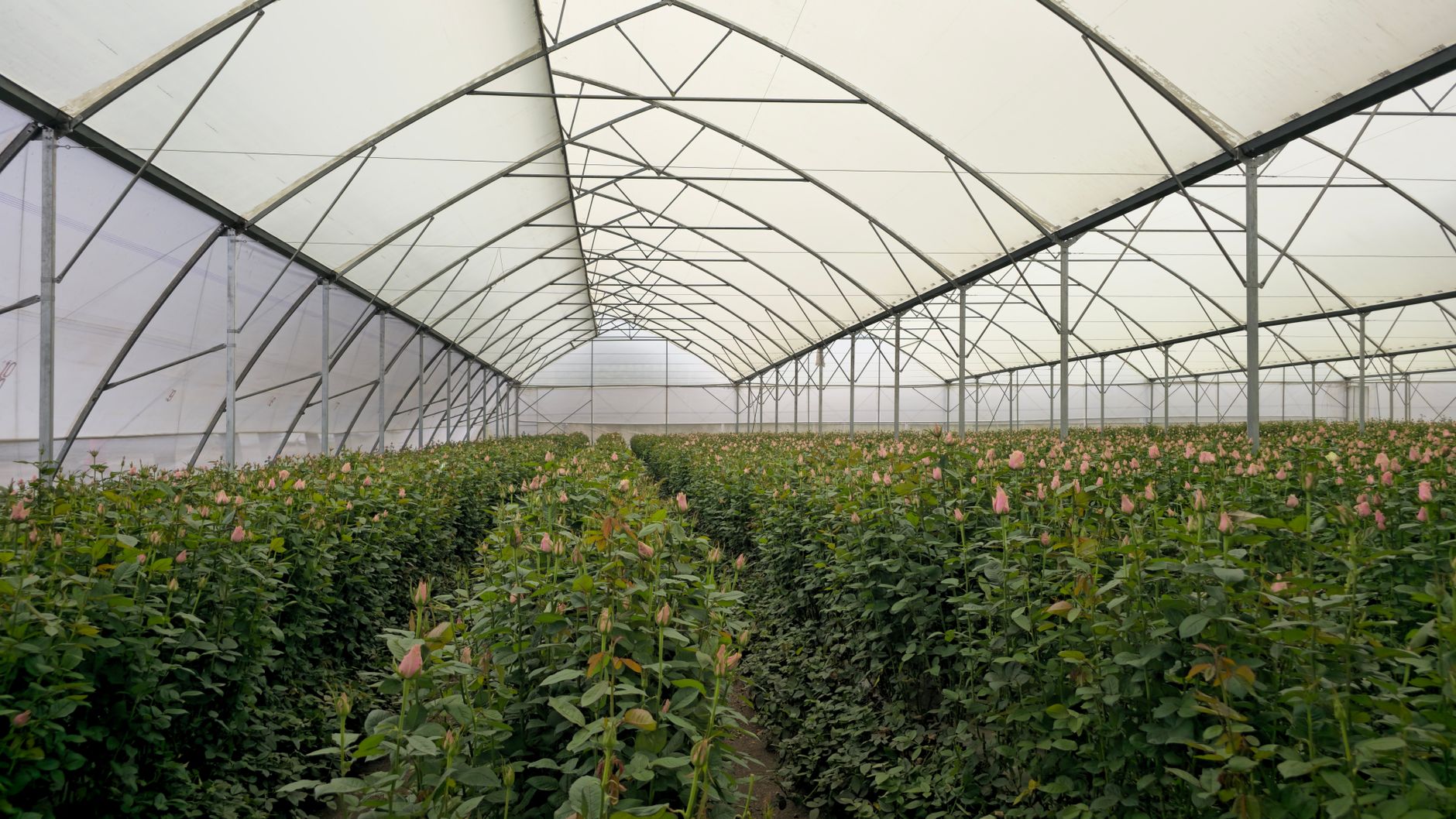
The world’s best commercial roses grow at high altitude near the equator. Ecuador and Colombia dominate global rose production, and the reason is geography: farms at 8,000–10,000 feet elevation get intense equatorial sunlight (which drives photosynthesis and color development) combined with cool nighttime temperatures (which slow growth and produce thicker stems, larger blooms, and more vibrant pigment). The result is roses with stems 60–80 centimeters long, heads the size of a child’s fist, and colors that are richer and more saturated than anything grown at sea level.
Colombia is the world’s second-largest flower exporter (after the Netherlands) and the largest exporter of cut flowers to the United States. Ecuador specializes in premium roses — the giant, long-stemmed varieties that show up in luxury arrangements and Valentine’s Day dozens. Together, these two countries produce the majority of fresh-cut roses sold in American flower shops.
But roses are just the headline. The global flower trade also sources lilies from the Netherlands, chrysanthemums from Colombia, gerbera daisies from Costa Rica, orchids from Thailand and Taiwan, tulips from the Netherlands and the Pacific Northwest, and hydrangeas from Colombia, Ecuador, and Kenya. The supply chain is genuinely global.
✂️ Harvest: The Clock Starts Now
Cut flowers are harvested by hand. Workers walk the rows at dawn, cutting stems at precise stages of bloom — roses are cut when the bud is just beginning to open (called the “marshmallow stage” for the way the petals feel), because a rose that opens too far on the farm will not survive the journey. Lilies are cut when the first bud shows color but before it opens. Tulips are cut tight. Hydrangeas are cut at full bloom because they do not open further after cutting.
Within minutes of cutting, stems go into buckets of hydration solution — water treated with floral preservative, antimicrobial agents, and sometimes a growth regulator that slows the bloom from opening during transit. Speed matters: a rose that sits un-hydrated for even 30 minutes in equatorial heat will lose vase life at the other end.
Stems are graded by length, head size, straightness, and color consistency. Premium grades go to export. Lower grades go to domestic markets or are composted. The grading is done by hand, quickly, on sorting tables in covered pack houses at the edge of the growing fields.
📦 Packing: Engineering for Fragility
Flowers are packed in standard cardboard boxes — called “full boxes” or “half boxes” depending on size — with stems bundled by variety, color, and grade. Each bundle is wrapped in paper or plastic sleeves for protection, and the stems are packed base-down into the box with the heads nested together to prevent crushing.
The boxes are designed for a specific purpose: they need to stack on pallets, fit into cargo aircraft, withstand pressure changes at altitude, and keep flowers cool and hydrated for 36–48 hours without refrigeration failure. Some boxes include gel ice packs. Some include wet paper around the stem bases. The engineering is precise because the margin for error is zero — flowers that arrive damaged or dehydrated are worthless.
✈️ The Miami Hub
Miami International Airport is the gateway for virtually all South American flowers entering the United States. Roughly 80% of all cut flowers imported into the U.S. pass through Miami, making it the single most important node in the American flower supply chain.
The airport has dedicated perishable cargo facilities — massive cold-storage warehouses on the airfield where flower shipments are unloaded, inspected, and reloaded without breaking the cold chain. The USDA inspects incoming shipments for pests, disease, and prohibited plant material. Customs processes the import paperwork. The entire turnaround — from aircraft to outbound truck — is designed to happen in hours, not days.
During peak holidays (Valentine’s Day, Mother’s Day), the Miami flower operation is staggering. Hundreds of cargo flights arrive from Bogotá and Quito in a single week. The cold-storage facilities run around the clock. Trucks line up at loading docks waiting for pallets. It is the most concentrated logistics bottleneck in the entire American floral industry, and any disruption — a weather delay, a customs slowdown, a labor action — ripples through every flower shop in the country within 48 hours.
🛣️ Distribution: Wholesale to Florist
From Miami, flowers move outward by refrigerated truck and, for West Coast destinations, sometimes by additional cargo flights. Regional wholesale distributors receive the shipments, break them down by variety and grade, and sell them to local florists.
Wholesalers operate their own cold-storage facilities and maintain standing orders with farms. A florist in Oregon or California might order through a wholesaler who receives Colombian roses, Dutch tulips, and California-grown greenery, all arriving on different schedules from different origins, consolidated into a single delivery to the shop.
Some larger florist operations buy directly from farms, especially for high-volume holiday orders. But most independent florists work through wholesalers, placing orders 2–3 times per week for the varieties and quantities they need. The relationship between a florist and their wholesaler is one of the most important in the business — a good wholesaler provides consistent quality, accurate availability, and honest communication when something is out of stock or delayed.
🏡 The Last Mile: Your Florist’s Cooler
When flowers arrive at a local shop, they are re-cut and re-hydrated. Every stem gets a fresh diagonal cut (to maximize water uptake), is stripped of lower leaves (to prevent bacterial growth in the vase), and goes into clean buckets with fresh preservative solution in the shop’s walk-in cooler. This step matters enormously — the re-cut and re-hydration after transit is what gives the flower its retail vase life.
Flowers sit in the cooler at 34–38°F until they are designed into arrangements. A well-managed florist cooler keeps flowers in suspended animation — hydrated, cool, and barely metabolizing — until they are needed. Some varieties (roses, carnations, alstroemeria) can hold in a cooler for several days without significant quality loss. Others (tulips, peonies, ranunculus) are more time-sensitive and need to be designed and delivered quickly.
When you order an arrangement, the florist pulls stems from the cooler, designs the piece on the workbench, and packages it for delivery — all within hours of your order. Same-day delivery means exactly that: ordered in the morning, designed by midday, delivered by afternoon. The flower that left Ecuador four days ago is now sitting on your kitchen table, looking like it just bloomed.
🌍 The Dutch Auction (and Why the Netherlands Still Runs Everything)
We have been talking about the South America–to–Miami pipeline, but the global flower trade has another center of gravity: the Netherlands.
The Dutch flower auction system, centered at Royal FloraHolland in Aalsmeer (near Amsterdam), is the largest flower trading platform on earth. Roughly 12 billion flowers and plants pass through FloraHolland every year. The auction uses the famous Dutch clock system — a giant clock on the wall starts at a high price and ticks downward; the first buyer to press their button gets the lot at whatever price the clock shows. It is fast, efficient, and brutally competitive.
Flowers arrive at Aalsmeer from all over the world — Kenya, Ethiopia, Colombia, Ecuador, Israel, and of course Dutch greenhouses. They are auctioned in the early morning hours, purchased by exporters and wholesalers, and shipped out the same day to destinations across Europe, Asia, and North America. A flower can be grown in Kenya, auctioned in the Netherlands, and on a kitchen table in London within 48 hours.
The Dutch domination of the global flower trade is not just about geography — it is about infrastructure, expertise, and centuries of horticultural tradition. The Netherlands has been a flower trading hub since the tulip mania of the 1630s, and the institutional knowledge, cold-chain logistics, and breeding programs that have developed since then give Dutch traders an almost insurmountable advantage.
💸 Why This Matters for Pricing
When you look at the price of a flower arrangement and wonder why flowers cost what they do, this supply chain is a big part of the answer. You are paying for:
- Manual harvesting on a high-altitude farm
- Grading, hydrating, and packing in a tropical pack house
- Refrigerated trucking to an international airport
- Cargo air freight across the equator
- USDA inspection and customs processing in Miami
- Refrigerated distribution to a regional wholesaler
- Wholesale markup and delivery to a local florist
- Re-cutting, re-hydrating, designing, and arranging by a skilled human
- Same-day delivery to your door
All for a product that is alive, perishable, and time-sensitive at every stage. There is no warehouse where flowers sit for weeks waiting to be sold. There is no “overstock” — flowers that do not sell within days are composted or donated. The entire supply chain runs on speed, precision, and the understanding that every hour of delay costs quality.
It is, frankly, remarkable that a dozen roses costs $50–$80 and not $500.
🌿 The Local Exception
Not everything comes from Ecuador. Depending on where your florist is located, a meaningful portion of seasonal inventory may come from domestic growers — California farms in Watsonville, Salinas, and the Central Valley; Oregon and Washington growers producing tulips, peonies, and dahlias; Hawaiian orchid farms; and local flower farms within driving distance of your city.
Domestic flowers skip the cargo jet and customs process, which reduces transit time and carbon footprint. They are often harvested and delivered within 24–48 hours. The trade-off is seasonality — domestic supply is heavily dependent on the time of year, while South American farms operate year-round near the equator.
The best florists blend both sources: imported staples (roses, carnations, chrysanthemums) that are available 365 days a year, plus seasonal domestic flowers (peonies in May, dahlias in August, tulips in spring) that bring variety, freshness, and a sense of time and place to the design.
💡 What You Can Do
You do not need to think about any of this when you order flowers. That is the whole point — the supply chain is invisible by design. But if you want to be a more informed flower buyer:
- Order from a real florist, not an aggregator. A local florist manages their own supply chain, inspects every stem, and designs fresh. Aggregator sites just forward your order to whoever is cheapest.
- Order early for holidays. Valentine’s Day and Mother’s Day strain the supply chain to its breaking point. Ordering early gives your florist the best selection.
- Ask for seasonal flowers. Your florist knows what is freshest and most available right now. Seasonal designs often look better and last longer because the flowers have not been forced out of season.
- Keep your arrangement cool. That cold chain the industry worked so hard to maintain? You are the last link. Keep flowers out of direct sunlight, away from heat vents, and change the water every couple of days.
Browse our arrangements, plants, and gifts. Same-day delivery. From farm to flight to florist to front door — and the rose still looks perfect. ✈️