
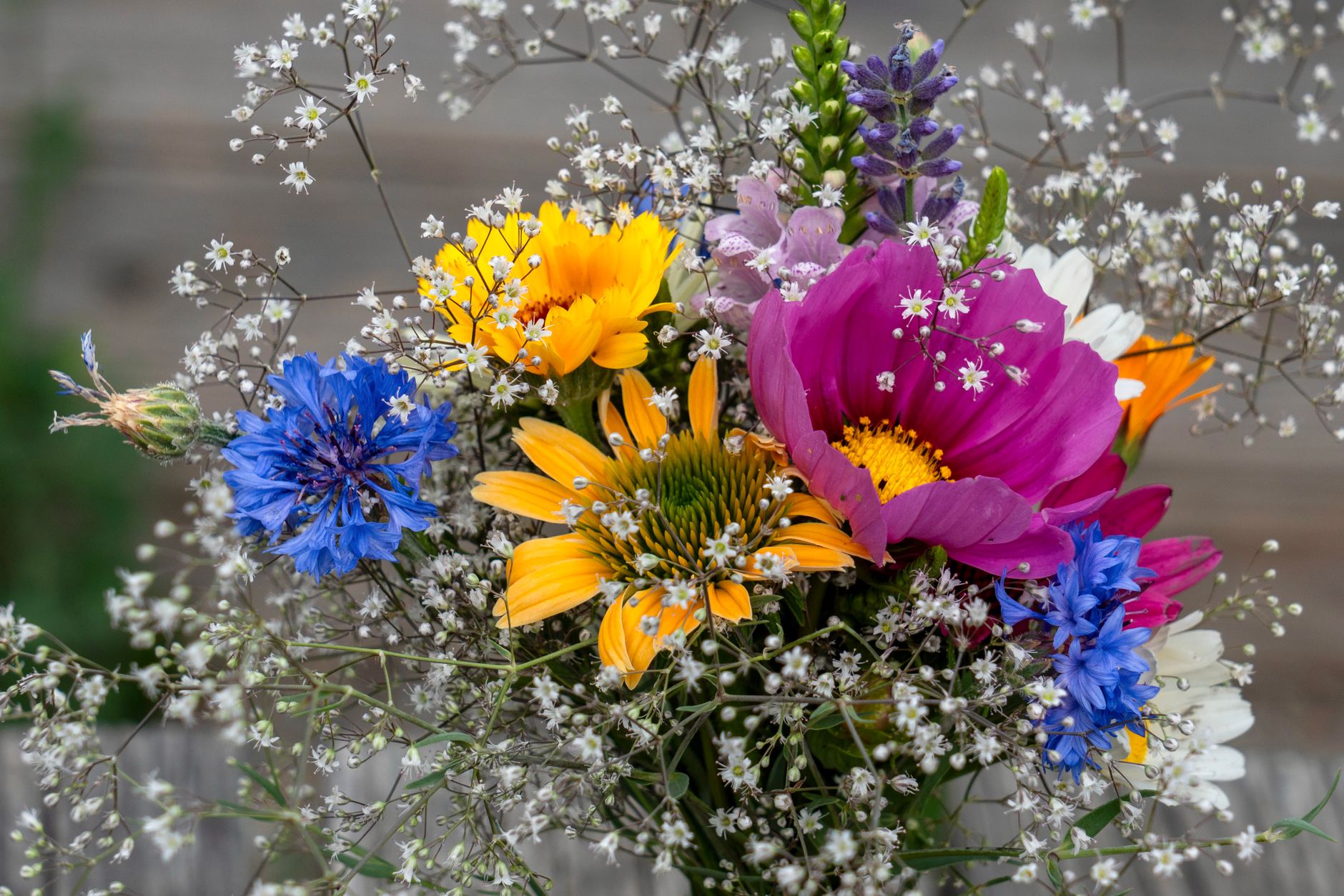
We name flowers on cards and invoices all day, every day, and it is easy to stop noticing that most of those names are actually tiny stories, compressed down to a single word. Some are genuine etymology, traceable through centuries of language. Others are folklore — charming, unverifiable, and repeated anyway because they explain something the flower itself cannot. Here are five names worth knowing the real story behind, sorted honestly into which is which.
🌸 Tulip: A Centuries-Old Translation Mix-Up
This one is documented, not legend. The word “tulip” traces back to the Persian word dulband, meaning “turban” — the same root that gives us the English word “turban” itself. When 16th-century European travelers encountered the flower in the Ottoman Empire and asked locals what it was called, the answer they got back described the turban the flower was often tucked into, not the flower's actual Turkish name (lâle). The mix-up stuck, traveled through Latin and French, and arrived in English as “tulip.” Which means “tulip” and “turban” are, linguistically speaking, siblings — both descended from the same Persian word, just by two completely different paths.
🐉 Snapdragon: Named for What Happens When You Squeeze It
Also documented, and also just delightful. The botanical name, Antirrhinum, comes from Greek words meaning roughly “nose-like,” a reference to the flower's snout-shaped bloom. But the common name comes from something more hands-on: squeeze the sides of an unopened snapdragon bloom gently, and its “jaws” pop open like a tiny dragon's mouth, then snap shut again when released. It is not just a party trick — that same mechanism exists so that only bumblebees and other strong pollinators are heavy enough to force the flower open and reach the nectar inside, while weaker insects simply cannot get in.
💉 Queen Anne's Lace: A Legend, Not a Documented Fact
Here is where we have to be honest: this one is folklore. The popular story goes that Queen Anne, while making lace, pricked her finger, and a single drop of blood fell onto the delicate white pattern — explaining the tiny dark purple-red floret found at the center of many Queen Anne's Lace umbels. It is a genuinely lovely explanation for a real botanical feature. It is also, as far as historians can tell, entirely unverifiable — there is no documented evidence any actual queen ever did this, or that the name originated this way at all. The dark center floret is real. The queen and the pricked finger are legend, repeated for generations because it explains the flower so satisfyingly that nobody wants to give it up.
💘 Forget-Me-Not: Another Legend, Just as Old
Also folklore, and also worth knowing. Medieval German legend tells of a knight walking along the Danube with the woman he loved, who spotted blue flowers growing at the water's edge. Weighed down by his armor, he lost his balance reaching for them and was swept away by the current. As he went under, he threw her the flowers and called out “Vergiss mein nicht!” — German for “forget me not.” She is said to have worn them for the rest of her life. Like Queen Anne's Lace, there is no historical record of this actually happening. It survives because it is exactly the kind of story a small blue flower with an urgent, memorable name deserves to carry.
📖 Black-Eyed Susan: A Real Poem, Not a Myth
Back to documented history for the last one. The name comes directly from a 1720 English ballad by poet John Gay, “Sweet William's Farewell to Black-Eyed Susan,” about a woman named Susan saying goodbye to her sailor sweetheart, William, before his ship departs. When European settlers encountered the golden wildflower with its dark central disk in North America, the resemblance to the ballad's dark-eyed heroine was apparently too good to pass up, and the name transferred directly onto the plant. As a bonus, there is a real companion flower named Sweet William (Dianthus barbatus) that often blooms at the same time — giving gardeners a small, unplanned reunion of the poem's two characters every season.
🌸 What This Means Next Time You Order
None of this changes how any of these flowers actually perform in a vase, but it is a nice thing to know standing at the counter. Some flower names are hard science wearing a nickname. Some are stories nobody can prove, kept alive because they are better than the truth. Either way, the next time a snapdragon shows up in an arrangement, you now know exactly why it earned that name — and the next time someone hands you Queen Anne's Lace, you can share the legend honestly, blood-drop and all, with the appropriate grain of salt.