
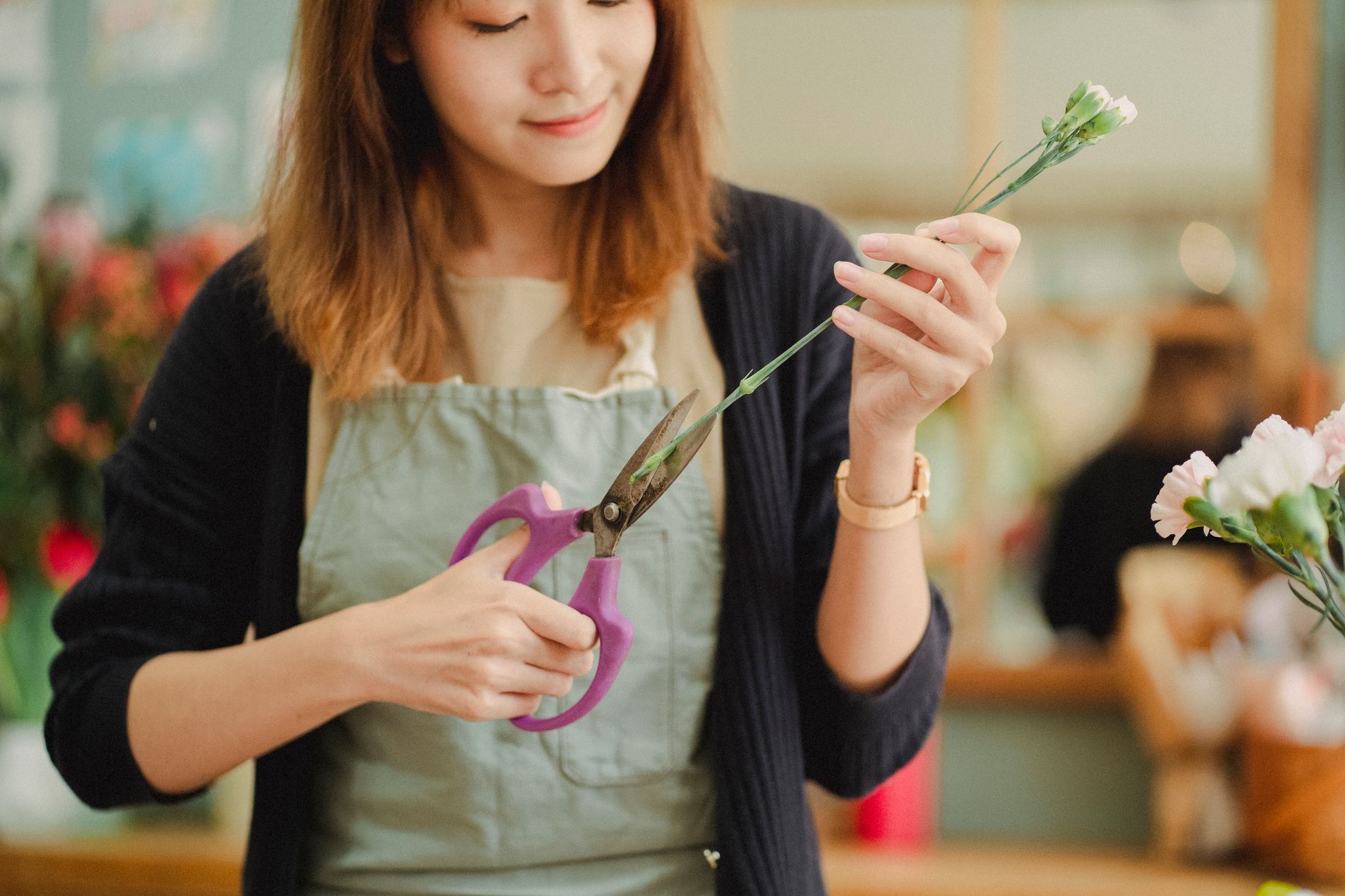
From the outside, floristry can look delightfully simple. You take some beautiful flowers, pop them in a vase, fluff them around a little, and suddenly you are a botanical genius with perfect taste and suspiciously calm hands.
In reality? Professional florists absolutely use special tools — and once you know what they are, it becomes very clear why. Flowers are delicate, stems are weirdly fibrous, branches can be surprisingly stubborn, and arrangements do not magically hold themselves together through sheer romance. Behind every polished bouquet is a tiny toolkit of sharp things, sticky things, wired things, and very florist-specific supplies doing quiet heroic work.
So yes: florists really do use special cutters, knives, scissors, and supplies that are unique to floristry or at least strongly associated with it. Some are straightforward. Some sound vaguely medieval. All of them exist because flowers are beautiful little divas that require proper handling.
✂️ First Up: Floral Scissors and Stem Cutters
Not all scissors are created equal, and your average kitchen scissors are not ideal for professional flower work. Florists often use floral scissors or stem cutters designed to make clean cuts through soft and semi-woody stems without crushing them.
That clean cut matters more than people realize. A crushed stem has a harder time taking up water, which means the flowers may age faster, droop sooner, or simply perform worse in the vase. A florist wants a quick, neat cut that opens the stem properly and keeps the arrangement looking fresh for as long as possible.
There are a few common variations:
- Florist shears for everyday stem cutting
- Bypass pruners for thicker or woodier stems like roses and branches
- Mini snips for detail trimming, ribbon work, and cleanup
If you have ever tried cutting a bundle of roses with dull scissors and ended up feeling like you were negotiating with a stubborn broom, this is exactly why florists keep better tools on hand.
🔪 Yes, Florists Really Use Knives
Florists also use floral knives, and they are one of the classic professional tools of the trade. A good floral knife is used for trimming stems, shaving woody ends, cutting floral foam, stripping leaves, and making quick precision adjustments while designing.
Many experienced florists prefer knives because they allow extremely fast, clean cuts once you know what you are doing. They are especially useful for flowers that benefit from an angled cut or for materials that do not behave nicely with bulkier shears.
That said, floral knives are also excellent at one additional task: reminding beginners to respect sharp objects. Professional florists make them look effortless. Newcomers often make them look like they should maybe sit down first and reconsider their grip.
🌹 Rose Strippers: Because Roses Fight Back
Roses are gorgeous. Roses are classic. Roses are also armed.
That is why some florists use rose strippers or stem-cleaning tools that help remove thorns and foliage more efficiently. Yes, thorns can be removed by hand. Yes, people have done that forever. No, it is not the most efficient option when you are processing multiple bunches for an event or a busy delivery day.
A rose stripper helps take off many of the small thorns and leaves quickly so the stems are cleaner, safer to handle, and ready for arranging. It is not always perfect, and some florists still prefer careful manual prep depending on the rose variety, but it is definitely one of those niche tools that makes immediate sense once you see how often roses show up in design work.
🧵 Floral Wire: The Secret Skeleton
If you have ever wondered how delicate flowers hold a pose, how boutonnières stay neat, or how certain blooms seem just a little too perfectly positioned, the answer is often floral wire.
Floral wire is one of the most important behind-the-scenes supplies in professional floristry. It comes in different gauges and is used to:
- Support weak stems
- Reinforce blooms for corsages and boutonnieres
- Attach materials together
- Create structure in intricate designs
- Help flowers sit exactly where the designer wants them
Without wire, many wearable flowers and event pieces would be much harder to build cleanly. It is basically the floral version of hidden engineering. You are not necessarily supposed to notice it. You are supposed to notice that everything looks beautifully composed and somehow stays that way.
🏷️ Floral Tape: Weird, Sticky, Essential
Then there is floral tape, which is one of the stranger and more magical florist supplies. Floral tape often feels a little waxy or papery, and many types become stickier when stretched. It is used constantly in corsages, boutonnieres, hand-tied work, and wired flower construction.
Its job is to bind, wrap, conceal, and stabilize. It is not glamorous, but it is incredibly useful. If floral wire is the hidden skeleton, floral tape is the muscle and connective tissue holding little design mechanics together.
This is also one of the clearest examples of a tool that feels distinctly florist-specific. Most households do not have floral tape hanging around unless someone in the home has either arranged flowers seriously or gone deep into craft-store optimism.
🧽 Floral Foam: Famous, Useful, Slightly Controversial
Floral foam has long been one of the signature supplies of the industry. The wet kind is designed to soak up water and hold stems in place inside containers, which makes it useful for centerpieces, sympathy designs, event work, and arrangements where precise placement really matters.
It helps florists create shape and stability fast. Need a low centerpiece with exact flower placement? Foam can help. Need an arrangement that ships or travels more securely? Foam can help there too.
That said, floral foam has become more debated in recent years because of sustainability concerns. Many florists now use it more selectively, look for lower-waste mechanics, or switch to alternatives like reusable cages, chicken wire structures, branch grids, mossing techniques, and tape grids. So yes, floral foam is still a real florist tool — but modern floristry is also increasingly creative about when and how to avoid it.
🏺 Frogs, Pin Holders, and Other Delightfully Odd Mechanics
One of the more charming corners of floristry involves tools that sound like either vintage antiques or characters from a children’s book. Enter the flower frog.
A flower frog, or pin holder, is a weighted device that sits in the bottom of a vessel and helps hold stems in place. Some are spiked metal discs. Some are ceramic. Some are glass. They are especially beloved in ikebana-inspired design and in more sustainable foam-free work.
These tools allow for clean, airy, sculptural arrangements with much less hidden bulk. They are wonderfully effective and just a little dramatic-looking, which honestly feels on brand for floristry.
Other mechanics florists may use include:
- Chicken wire shaped inside containers for support
- Tape grids across vase openings
- Water tubes for individual stems in installations or bouquets
- Floral cages for mounted or structured designs
None of these are especially glamorous. All of them are how a lot of the magic happens.
🚿 Buckets, Hydration, and Processing Supplies
A florist’s toolkit is not just about cutting and construction. It is also about flower care. Before flowers ever make it into an arrangement, they need to be processed correctly. That means hydration, conditioning, leaf removal, re-cutting, storage, and clean handling.
That is why florists rely on practical supplies like:
- Deep floral buckets for hydration and storage
- Flower food and hydration solutions
- Cleaning supplies and sanitizers for buckets, tools, and work surfaces
- Ribbon scissors and wrapping tools
- Waterproof wrap, sleeves, tissue, and kraft paper for presentation and delivery
This part of floristry is less cinematic than the bouquet reveal, but it is a huge part of why professional flowers tend to look better and last longer. The tools are not just about style. They are about performance.
💡 Are These Tools Truly Unique to Floristry?
Some are unique, and some are specialized versions of more general tools.
Floral tape, floral wire, water tubes, corsage pins, and many bouquet mechanics are very strongly associated with floristry. A flower frog may also fall into that category, even though it overlaps with decorative arts and ikebana traditions.
Scissors, knives, and pruners are not unique in the absolute sense, of course. But the versions florists use are often chosen very specifically for stem work, hand comfort, speed, and precision. In that sense, yes, they become florist tools because they are selected for florist problems.
It is a little like cooking. A knife is not unique to chefs, but a chef’s knife in trained hands is definitely part of a professional system. Same idea here, just with more roses and slightly more ribbon.
🌸 Why the Tools Matter More Than People Think
People sometimes assume floristry is mostly taste. Taste matters, obviously. But professional floral design is also part horticulture, part mechanics, part logistics, part styling, and part speed. The right tools help florists work cleaner, faster, and with less damage to the flowers.
They also help solve specific problems:
- How do you keep a weak stem upright?
- How do you make a boutonnière survive a full event?
- How do you create a symmetrical centerpiece that still looks organic?
- How do you process dozens of stems quickly without wrecking them?
- How do you make delicate flowers travel well enough to arrive looking fresh and elegant?
The answer is rarely, “Just hope for the best.” It is usually, “Use the proper florist tools and mechanics, then make it look effortless.”
✨ The Bottom Line
So, do florists use special tools? Absolutely. Floral shears, knives, pruners, rose strippers, floral wire, floral tape, foam, frogs, water tubes, pins, cages, hydration products, and a whole cast of surprisingly specific supplies are part of the job.
Some tools are about efficiency. Some are about flower health. Some are about structure. Some are about making a tiny spray rose behave itself for once in its life. Together, they turn raw stems into bouquets, centerpieces, sympathy pieces, wearable flowers, and event designs that actually hold up in the real world.
So the next time you admire a florist’s work, remember: yes, there is artistry involved. But there is also a toolkit nearby full of sharp, sticky, wire-covered proof that beauty often needs a little engineering. 🌸✂️🛠️