Let’s get something out of the way: we are florists, not dispensaries. We do not sell cannabis. We do not arrange cannabis. We will not be putting a bud in your anniversary bouquet (though honestly, for some couples, that might be the most thoughtful gift of all).
But we are plant people. And cannabis is, undeniably, one of the most fascinating plants on Earth. Today — April 20th, the unofficial holiday of cannabis culture — feels like the right moment to talk about it the way florists talk about any remarkable flower: the biology, the beauty, the growing conditions, and the reasons humans have been cultivating this one species with such devotion for millennia.
🌱 Cannabis Is, Botanically Speaking, a Flowering Plant
This is not a metaphor. Cannabis (Cannabis sativa, Cannabis indica, and their hybrids) is a flowering plant in the family Cannabaceae — which also includes hops (Humulus lupulus), the plant that gives beer its bitterness and aroma. Cannabis and hops are botanical cousins. If you have ever buried your nose in a fresh hop cone and thought “this smells vaguely familiar,” now you know why.
Like all flowering plants, cannabis produces flowers as its reproductive structure. The “buds” that cannabis culture obsesses over are literally the unfertilized female flowers of the plant — dense clusters of pistils, calyxes, and trichomes, held together in a tight inflorescence. In botanical terms, a cannabis bud is structurally not so different from a zinnia head or a dahlia bloom: a compact arrangement of many tiny individual flowers grouped together.
🌺 The Anatomy of a Cannabis Flower
If you looked at a cannabis flower through a florist’s lens, here is what you would see:
- Pistils — the hair-like structures that start white and turn orange, red, or brown as the flower matures; these are the reproductive organs that would catch pollen if a male plant were nearby (growers prevent this to keep flowers seedless)
- Calyxes — the small, teardrop-shaped structures that form the body of the bud; each calyx is technically an individual flower
- Trichomes — the tiny, mushroom-shaped glands that cover the flower surface and produce the resin (cannabinoids, terpenes, and flavonoids); under magnification they look like a forest of crystalline lollipops
- Bracts — the leaf-like structures that enclose and protect the calyxes; what most people think of as the “bud” shape is largely the bracts
- Cola — the main flower cluster at the top of the plant; in florist terms, think of it like the terminal bloom on a rose stem or a sunflower head
The trichomes are what make cannabis unique in the plant world. While many plants produce trichomes (tomatoes, for example, have fuzzy stems for the same basic reason), cannabis trichomes produce an extraordinary range of aromatic compounds — more than 200 terpenes and 100+ cannabinoids. No other flower on Earth has this chemical complexity.
💨 Terpenes: Where Cannabis and Traditional Flowers Overlap
Here is where it gets interesting for florists: the terpenes that give cannabis its aroma are the exact same molecules found in traditional flowers and herbs. Cannabis does not have its own special chemistry — it borrows from the same aromatic palette as the rest of the botanical world:
- Linalool — the primary scent compound in lavender; also present in many cannabis strains, giving them a floral, calming aroma
- Myrcene — found in hops, mangoes, and bay leaves; the most common terpene in cannabis; earthy, musky, herbal
- Limonene — the citrus brightness in lemon peel, orange blossoms, and citrus-forward cannabis strains
- Pinene — the fresh, resinous scent of pine needles and rosemary; responsible for the “forest” note in some cannabis varieties
- Caryophyllene — the spicy, peppery note in black pepper, cloves, and certain cannabis strains
- Geraniol — the sweet, rosy scent in geraniums and roses; present in some cannabis cultivars
When a cannabis enthusiast says a strain “smells like lavender and citrus,” they are being literally accurate. The molecules are identical. The same linalool that makes your lavender sachet smell calming is produced by certain cannabis trichomes for the exact same evolutionary reason: to attract pollinators and repel pests.
🏡 Growing Cannabis vs. Growing Flowers: More Similar Than You Think
Cannabis growers and flower growers have more in common than either group usually admits:
- Light cycles matter enormously — cannabis flowers when day length shortens (short-day plant), just like chrysanthemums and poinsettias; commercial growers manipulate light schedules to trigger flowering, exactly as greenhouse flower producers do
- Temperature and humidity control — optimal cannabis growing conditions (65–80°F, 40–60% humidity) are nearly identical to what a rose greenhouse targets
- Variety obsession — the sheer number of cultivated varieties (thousands of named strains) mirrors the world of roses, dahlias, and orchids; breeders in both worlds chase color, aroma, form, and vigor
- Harvest timing is critical — cut flowers have an optimal harvest window measured in hours; cannabis flowers have an optimal harvest window measured in days; both degrade if you miss it
- Post-harvest handling — cut flowers go into water and conditioning solution; cannabis goes into drying and curing rooms; both processes are about preserving freshness and extending the experience
🌍 A (Very) Brief History of Humans and Cannabis
Cannabis has been cultivated by humans for at least 10,000 years — making it one of the oldest domesticated plants, alongside wheat, rice, and flax. It was grown for fiber (hemp) in Central Asia, for medicine in ancient China, for ritual use in India, and eventually for all of the above everywhere else.
The flowers specifically have been prized for thousands of years. Ancient texts from India, Persia, and the Arab world describe cannabis flowers as medicine, intoxicant, and spiritual tool. The Scythians — nomadic warriors of the Central Asian steppe — burned cannabis flowers in enclosed tents as a ritual practice 2,500 years ago (Herodotus wrote about it, somewhat bewildered).
In the flower world, roses have about 5,000 years of documented cultivation history. Cannabis has about double that. In terms of how long humans have been obsessed with a single bloom, cannabis may be unmatched.
🌿 Cannabis as an Ornamental: Would It Work in a Vase?
Florists get asked this more than you might think. The honest answer:
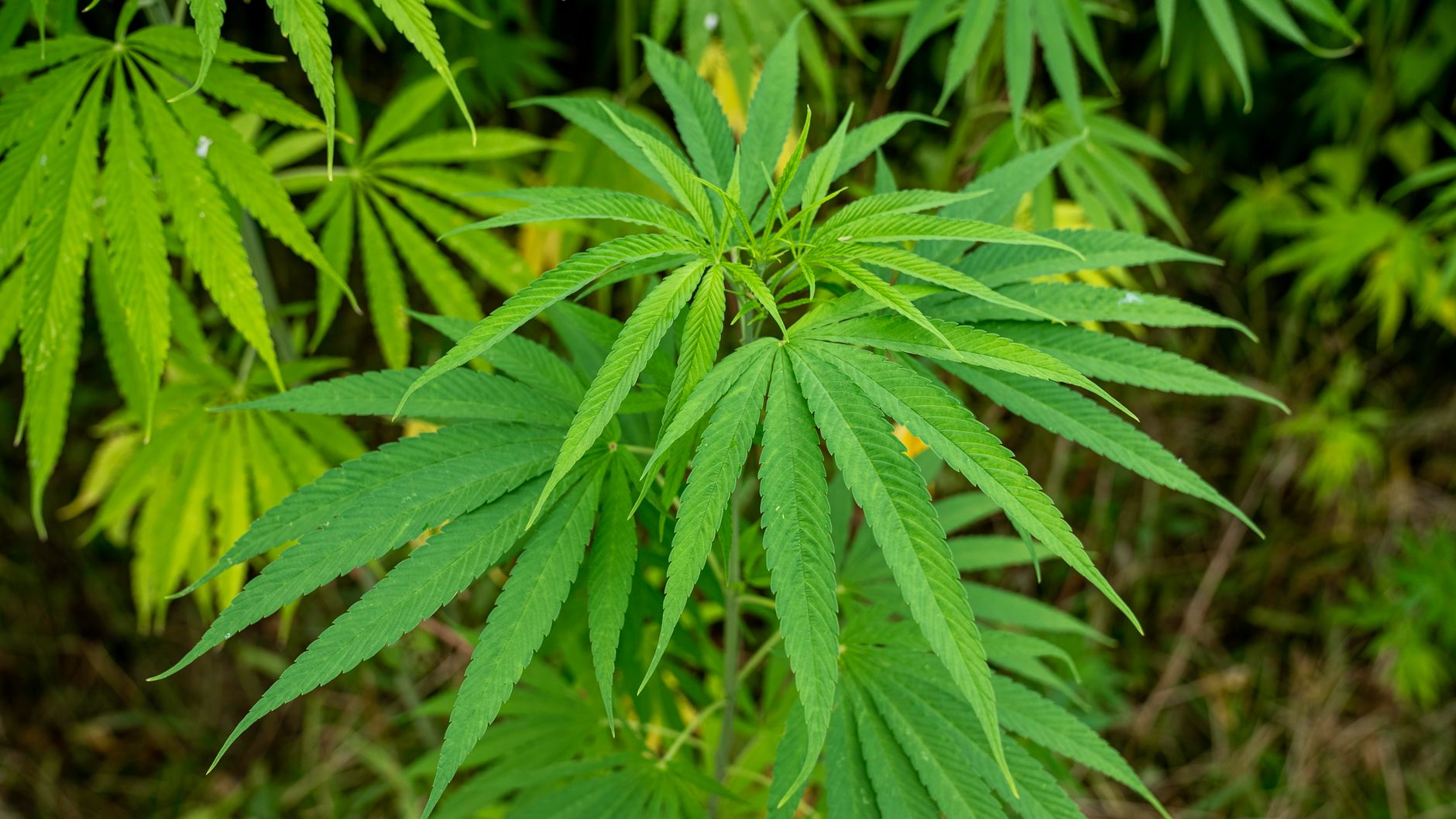
- The foliage is genuinely beautiful. The iconic fan leaves — 5, 7, or 9 pointed leaflets radiating from a central stem — have a structural elegance that works in modern, minimalist arrangements. The color ranges from bright green to deep purple depending on variety and temperature.
- The flowers are visually striking up close but do not have the “read from across the room” impact that roses, dahlias, or lilies do. They are a textural element, not a focal flower.
- The aroma is... assertive. A bouquet with cannabis in it would smell like cannabis. For some recipients this is a feature; for others, very much not.
- Legal issues aside, from a pure design standpoint, hemp foliage (legal, low-THC) could absolutely work as a greenery element in arrangements the same way eucalyptus, fern, or willow do. The leaf shape is architecturally interesting and immediately recognizable.
💬 What This Has to Do with Your Next Bouquet
Nothing, directly. We are still a flower shop. We still send roses, lilies, sunflowers, and orchids. But the point of 4/20 — the real point, underneath the jokes and the culture — is appreciation for a plant. And that is something florists understand deeply.
Every flower we work with has a story: where it evolved, why it looks the way it does, what purpose its color or scent serves in the wild. Cannabis is no different. It is a flower that happened to produce compounds that interact with human brain chemistry in a way no other plant does, and that accident of evolution made it one of the most cultivated, debated, celebrated, and regulated plants in human history.
So today, whether you are celebrating 4/20 or not, take a moment to appreciate the botanical world in all its weird, wonderful, sometimes-controversial glory. And if you want to send someone flowers — the legal, vase-friendly kind — we are always here.
Browse our seasonal bouquets, our living plants, or if you want something with an herbal, earthy, “green” vibe, ask us about arrangements with eucalyptus, rosemary, or lavender. We will make it beautiful. 🌿