On Saturday, July 4, 2026, the United States of America turns 250 years old.
That number is worth pausing on. A quarter of a millennium. Ten generations. The span from a handwritten declaration in a Philadelphia statehouse to a country of 340 million people stretching from the Atlantic to the Pacific to Alaska to Hawaii to territories in the Caribbean and the Pacific. And in all that time — through revolution, expansion, civil war, immigration, industrialization, depression, world wars, civil rights movements, moon landings, and everything in between — flowers have been part of the story.
This is not a normal 4th of July. This is the semiquincentennial. It happens once. Your great-grandchildren will not see the next one. And while fireworks will do most of the heavy lifting on Saturday night, flowers deserve a place at the table — literally and figuratively. Here is a florist’s look at what bloomed in 1776, what traveled here since, what fireworks and flowers have in common, and why the 250th birthday of a nation built by people from everywhere deserves an arrangement that reflects that.
🌼 What Was Blooming in 1776
When the Continental Congress voted for independence on July 2, 1776, and adopted the Declaration on July 4, the American landscape was already extraordinary — a continent of wildflowers, native plants, and botanical diversity that European botanists were only beginning to catalog. Here is what was in bloom that first July:
- Black-eyed Susans (Rudbeckia hirta). Native, abundant, golden-yellow with dark centers. They were blooming across meadows from New England to the Carolinas. One of the most recognizably American wildflowers.
- Coneflowers (Echinacea). Purple, pink, and white, native to the prairies and Eastern woodlands. Indigenous peoples had used them medicinally for centuries before European contact.
- Mountain laurel (Kalmia latifolia). The state flower of Pennsylvania — the very state where independence was declared. Its pink-white clusters were blooming in the Appalachian forests that July.
- Wild bergamot and bee balm (Monarda). Red, purple, and lavender, attracting hummingbirds and pollinators across the Eastern colonies. The leaves were used as tea — a pointed choice after the Boston Tea Party made imported tea politically complicated.
- Trumpet vine (Campsis radicans). A native climber with orange-red flowers that hummingbirds fight over. It was covering fences and walls throughout the mid-Atlantic and Southern colonies.
- Sunflowers (Helianthus annuus). Indigenous to the Americas, cultivated by Native peoples for thousands of years before European arrival. By 1776, they were growing in colonial gardens too — one of the earliest crops to move from Indigenous agriculture into European-American cultivation.
These were not ornamental imports. These were American flowers — growing on American soil long before anyone called it America. When we include native wildflowers or American-origin species in a 250th arrangement, we are honoring the land itself.
🌍 What Traveled Here Since
The botanical story of America is an immigration story. Almost every flower you see in a modern florist shop arrived from somewhere else, brought by someone who wanted a piece of home in a new country:
- Roses: European and Asian cultivars arrived with the earliest colonists. By 1800 they were in every ambitious garden in the new republic. Today the rose is the national flower of the United States (designated by Congress in 1986).
- Chrysanthemums: Arrived from East Asia via European collectors in the late 1700s. Now one of the most popular flowers in America.
- Tulips: Dutch and Ottoman origins, arriving via European settlers. By the 1800s, American nurseries were breeding their own varieties.
- Lavender: Mediterranean origins, brought by English and French settlers. Now grown commercially in Oregon, Washington, and California — thriving in climates that remind it of Provence.
- Dahlias: Native to Mexico and Central America, where the Aztecs cultivated them. They traveled to Europe first, then returned to North America as ornamental hybrids. A flower that crossed the border before borders existed.
- Carnations: Mediterranean and Asian origins, arriving with European settlers. Now grown in massive quantities in Colombia and Ecuador and shipped back to the Americas daily.
- Cherry blossoms: Japan’s gift to Washington, D.C., in 1912. Now synonymous with the nation’s capital in spring.
- Bird of paradise: South African, arriving via botanical gardens and the cut-flower trade. Now a symbol of tropical abundance in American arrangements.
An American flower arrangement in 2026 is, by definition, multicultural. The stems in a single bouquet may represent five continents and a dozen countries of origin. That is not an accident. That is the country.
🎆 What Fireworks and Flowers Have in Common
This parallel is more real than it sounds. Stand back and think about what fireworks actually are:
- Orchestrated bursts of color against a dark background. That is also a description of a well-designed bouquet against a table or a wall.
- Ephemeral. Fireworks last seconds. Flowers last days. Both are beautiful precisely because they do not last forever. The impermanence is the point.
- Engineered to create emotion. A pyrotechnician chooses chemicals and timing to produce awe. A florist chooses stems and placement to produce the same thing. Both are designers working with color, scale, and rhythm.
- Best experienced with other people. Nobody watches fireworks alone by choice. Nobody puts flowers on a table for a dinner they are eating alone (well, sometimes — and that is its own kind of beautiful). Both are communal. Both say: we are here, together, and this moment matters.
- The grand finale is the point. In fireworks, the finale is the rapid-fire crescendo at the end. In flowers, the “finale” is when the buds all open on day three and the arrangement reaches peak bloom. Both build toward a moment of maximum beauty.
On Saturday night, after the fireworks fade and the smoke drifts over the neighborhood, your flowers will still be there. On the table, on the porch, in the kitchen. Sunday morning, Monday morning, the whole next week. The fireworks gave you the spectacle. The flowers give you the memory.
🇺🇸 A 250th Arrangement: What It Should Include
If we were designing an arrangement specifically to honor America’s 250th — not just patriotic colors, but the idea of 250 years — here is what we would reach for:
- Something native. Black-eyed Susans, coneflower, or sunflowers — stems that were here before the nation existed. They anchor the arrangement in the land itself.
- Something that traveled here. Roses (the national flower), dahlias (Mexican origin, returned via Europe), lavender (Mediterranean via immigrant gardens). These represent the people who built the country.
- Red, white, and blue — done right. Deep red garden roses, not fire-engine carnations. White stock or lisianthus for elegance. Blue delphinium or hydrangea for genuine (not dyed) blue. We covered the full patriotic palette guide in detail.
- Texture and wildness. Queen Anne’s lace, thistle, seeded eucalyptus, fern. The arrangement should feel gathered, not rigid — the way America itself is gathered from a thousand sources into something unified and a little wild.
- Scale. This is the 250th. Go bigger than usual. An extra stem, a taller vase, a second arrangement for the porch. This is not a regular Tuesday. This is a once-in-a-lifetime Saturday.
🎉 How to Celebrate With Flowers This Week
- Your own table. Whether you are hosting a cookout or a quiet dinner, flowers on the table make the 4th feel intentional. A low, wide arrangement in a bowl that people can see over while talking — that is the move.
- A hostess gift. Showing up to someone’s 4th of July party with a hand-tied bouquet in red, white, and blue makes you the person everyone remembers. Not the one who brought chips. The one who brought beauty.
- A veteran or service member. The 250th lands differently for people who served. A delivery to a veteran, an active-duty family, or a Gold Star family on Saturday says something no text message can.
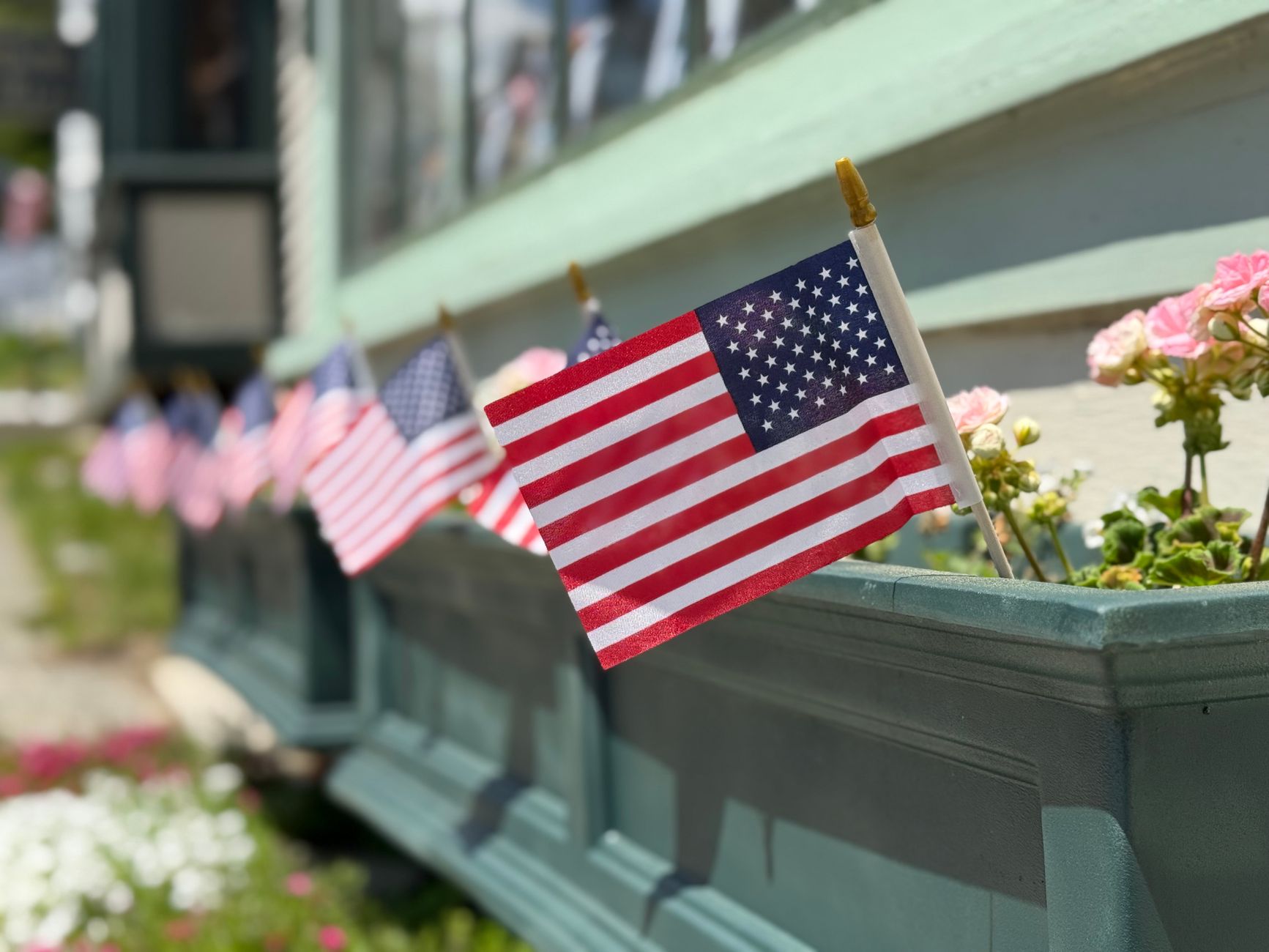
- A porch display. Red geraniums, white petunias, blue lobelia in a pot flanking the front door. Or a designed arrangement on the porch table. Neighbors walking past on the 4th will notice. This is the day for visible, generous, public beauty.
- Someone far away. The 4th is a family holiday. If someone you love cannot be there — a parent in another state, a grandparent in a care facility, a friend who moved across the country — flowers delivered on Friday morning say: we are still connected, even across the distance. Happy 250th.
📅 Order This Week
Blue flowers sell out first. Delphinium, blue hydrangea, and cornflowers are in high demand before the 4th and supply is finite. If you want genuine blues in your arrangement, order by Wednesday. Thursday and Friday orders will still be beautiful, but early orders get our best inventory and our most creative attention.
Browse our arrangements — mention “250th” or “semiquincentennial” or just “red white and blue” in your order notes and we will build something worthy of the occasion. Same-day delivery available. This is the birthday that only happens once. The flowers should match the moment.